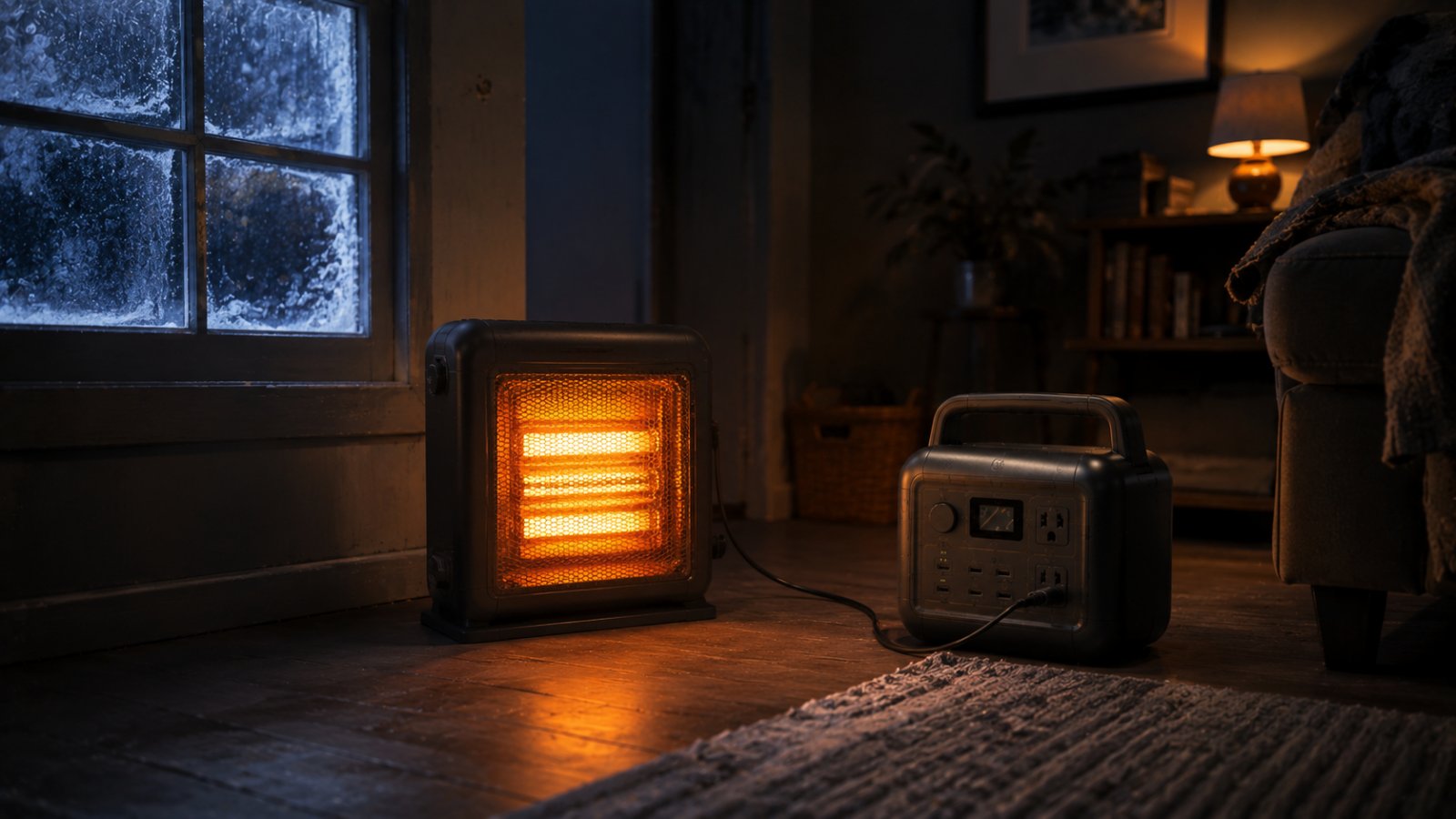
Can a Power Station Run a Space Heater? What You Can/Can’t Do
Quick answer: yes, a power station can run a space heater — if its output rating meets the heater’s wattage (most heaters need 1,500 W, so you need an 1,800 W-class unit). But here’s the catch: space heaters are enormous power hogs, so even a big battery drains fast. A 1,000 Wh unit runs a 1,500 W heater for only about 30–40 minutes, and a 2,000 Wh unit for about 1 hour 20 minutes. So while it’s possible, it’s rarely practical for sustained heat — and there are much smarter ways to stay warm.
Let’s break down exactly what you can and can’t do, and how to stay warm efficiently.
The output problem: can it even turn on?
First, your power station’s continuous output rating must meet or exceed the heater’s wattage:
- Most space heaters run at 1,500 W on high (750 W on low).
- To run one on high, you need a unit rated 1,500 W or more — realistically an 1,800 W-class unit (like the EcoFlow Delta 2) for headroom.
- Smaller units (300–1,000 W output) can’t run a 1,500 W heater at all — the heater simply won’t turn on, or the station will shut off from overload.
Some units with “X-Boost” or similar features can run a 1,500 W heater on a nominally lower-rated inverter, but you still hit the real problem: energy.
The energy problem: it drains fast
This is the dealbreaker. Space heaters convert electricity directly to heat, which is extremely energy-intensive — they draw their full wattage continuously, unlike a fridge that cycles. So the runtime math is brutal:
Runtime = battery capacity (Wh) × 0.85 ÷ heater watts
|
Power station capacity |
1,500 W heater (high) |
750 W heater (low) |
|---|---|---|
|
500 Wh |
won’t run / ~17 min |
~30 min |
|
1,000 Wh |
~30–40 min |
~1 hour |
|
2,000 Wh |
~1 hr 10 min |
~2 hr 15 min |
|
3,000 Wh |
~1 hr 40 min |
~3 hr 20 min |
Even a large 2,000 Wh unit gives you barely over an hour of a 1,500 W heater. A space heater is, quite simply, the fastest way to empty a power station. See Watt-Hours Explained for why.
What you CAN do
Run a heater briefly to take the chill off. A power station can run a space heater for 30–60 minutes to warm a small room quickly, then switch to more efficient methods. This is fine for a quick warm-up.
Use the low setting. Running a heater at 750 W instead of 1,500 W roughly doubles your runtime — still limited, but better.
Run one on a large or expandable unit. A 2,000 Wh+ or expandable unit gives you meaningful (if still short) heater runtime for a small space.
What you CAN’T do (practically)
Heat your home overnight with a space heater on battery. The energy demand is simply too high — you’d need an enormous, expensive battery, and it’d still drain in hours. This isn’t a realistic use.
Run a heater for long, sustained periods on a typical power station. It’s the wrong tool for continuous heating.
Smarter ways to stay warm on battery power
If your goal is warmth during an outage or while camping, skip the space heater and use far more efficient options:
Heated blankets and clothing. A heated blanket draws only ~50–100 watts — a fraction of a space heater. A 1,000 Wh power station can run one for 8–15+ hours, keeping you genuinely warm all night. This is the single best trick for battery-powered warmth.
Run your furnace blower on the power station. A gas furnace’s blower draws only a few hundred watts, so a power station can run your whole home’s heat efficiently — far smarter than a space heater. See How to Keep Your Heat On During a Winter Power Outage.
Indoor-rated propane heaters. For serious heat without draining a battery, a propane heater rated for indoor use (with proper ventilation and a CO detector) provides warmth independent of electricity.
Heated seat cushions, hand warmers, and hot water bottles. Tiny power draws for targeted warmth.
The theme: direct electric heating is hugely inefficient on battery, but heating people (blankets) or moving existing heat (furnace blower) sips power by comparison.
Limitations and who this isn’t for
Most electric space heaters draw around 1,500W continuously, which is brutal on a battery: even a large power station may last only an hour or two, and smaller units can’t run one at all. Heaters also surge and can trip smaller inverters. For outage heat a power station is a short-term stopgap at best — never rely on it for prolonged heating, and never use fuel heaters indoors.
How we source this guide: capacities, runtimes and prices are drawn from manufacturer documentation and reputable public sources and can change. Always confirm current specifications and pricing on the manufacturer’s website before buying.
Frequently asked questions
Can a power station run a space heater? Yes, if its output rating meets the heater’s wattage (usually 1,500 W, so you need an 1,800 W-class unit). But space heaters drain batteries very fast — a 1,000 Wh unit runs a 1,500 W heater for only ~30–40 minutes, so it’s rarely practical for sustained heat.
How long will a power station run a space heater? Not long: about 30–40 minutes for a 1,500 W heater on a 1,000 Wh unit, or ~1 hour 20 minutes on a 2,000 Wh unit. Running the heater on low (750 W) roughly doubles those times. Heaters are the fastest way to drain a power station.
What size power station do I need for a space heater? To run a 1,500 W heater at all, you need an 1,800 W-class output. But for meaningful runtime, you’d need a very large (2,000 Wh+) or expandable unit — and even then it’s short. A heated blanket is a far better use of battery power.
Why does a space heater drain a power station so fast? Because it converts electricity directly to heat, drawing its full 1,500 watts continuously. That’s enormous compared to electronics — a 1,500 W heater uses in one hour what a 100 W device uses in 15. Direct electric heating is inherently battery-hungry.
What’s a better way to stay warm on a power station? A heated blanket (only ~50–100 W) runs 8–15+ hours on a 1,000 Wh unit — far better than a space heater’s 30–40 minutes. Even better, run your gas furnace’s blower (a few hundred watts) on the power station to heat your whole home efficiently.
What’s the biggest power station I’d need to run a space heater all night? Impractically large — a 1,500 W heater running 8 hours needs ~12,000 Wh, which would take a massive, expensive battery bank. This is why a heated blanket (~50–100 W) is the realistic solution for battery-powered warmth overnight.
Can a solar generator run a space heater? Only briefly, and only if its output meets the heater’s wattage (1,800 W-class). Even with solar recharging, a heater’s massive continuous draw outpaces what panels can supply in real time, so it’s not a practical way to heat with a solar generator.
The bottom line
Can a power station run a space heater? Technically yes — if the output rating is high enough (1,800 W-class) — but practically, no: space heaters drain even large batteries in under an hour, making them a poor match for battery power. Use one only for a quick 30–60 minute warm-up. To actually stay warm on a power station, use a heated blanket (~50–100 W, all night on a 1,000 Wh unit) or run your furnace blower — both sip power compared to a space heater’s massive draw. Heat the person or move existing heat; don’t try to make heat from scratch on a battery.