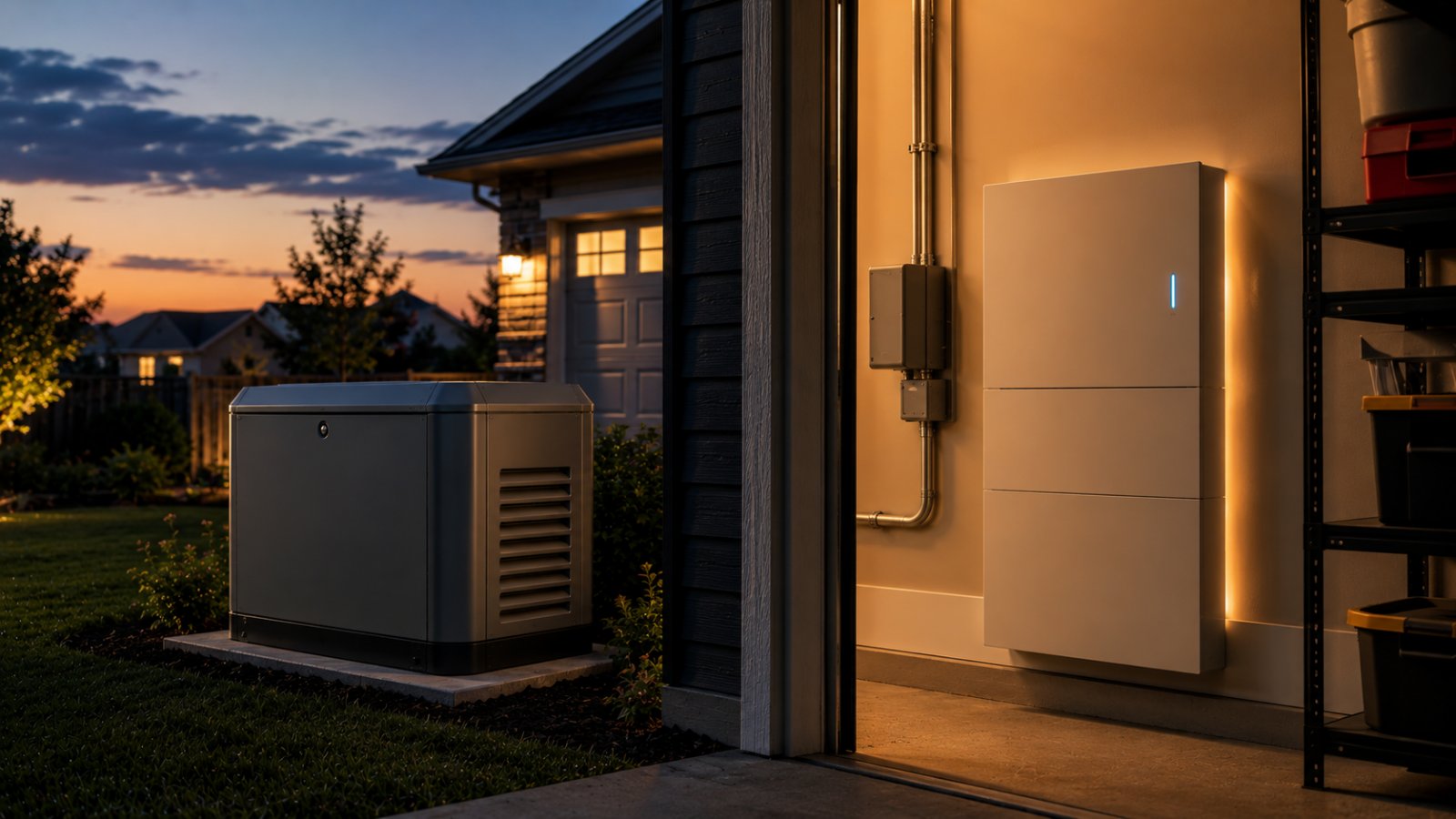
Standby Generator vs Battery Backup: Which Is Right for You?
You’ve decided to stop losing power every storm — now the big question: a standby generator or a home battery backup system? Both provide automatic whole-home backup, both wire into your electrical panel, and both cost thousands. But they work in completely opposite ways, with very different trade-offs in runtime, noise, cost, and upkeep. Choosing right saves you money and headaches.
Here’s the honest, head-to-head comparison of standby generator vs battery backup for 2026.
Note: Both options require professional installation. Cost figures are general estimates — get local quotes.
The quick verdict
- A standby generator wins for long, multi-day outages and unlimited runtime — fueled by a gas line, it runs indefinitely and handles the heaviest whole-home loads.
- A battery backup wins for silent, clean, instant, maintenance-free power, bill savings, and pairing with solar — ideal for the shorter outages most people actually face.
- The most resilient homes use both: a battery for silent, everyday, instant backup, and a generator (or solar) to extend runtime through rare, long outages.
Side-by-side comparison
|
Factor |
Standby Generator |
Battery Backup |
|---|---|---|
|
Runtime |
Unlimited (with fuel) |
Limited by capacity |
|
Noise |
Audible (quieter than portables) |
Silent |
|
Emissions |
Yes (runs outdoors) |
None |
|
Fuel |
Natural gas or propane |
Grid or solar (no fuel) |
|
Startup |
Automatic (a few seconds) |
Instant (milliseconds) |
|
Maintenance |
Regular (oil, filters, service) |
Almost none |
|
Bill savings |
No |
Yes (time-of-use, solar) |
|
Whole-home heavy loads |
Excellent |
Good (with enough capacity) |
|
Lifespan |
~10–20 years (with upkeep) |
~10–15 years |
|
Upfront cost |
~$8,000–$18,000 installed |
~$10,000–$20,000+ installed |
Where a standby generator wins
Unlimited runtime. This is the decisive advantage. Fueled by a natural gas line, a standby generator runs for days or weeks straight — as long as the gas flows. In a prolonged, multi-day outage, it never runs out, while a battery eventually depletes.
Heavy whole-home loads. A 22–26 kW standby generator can run an entire large home at once — multiple AC units, well pump, electric range, everything — without rationing. Matching that with batteries requires a large, expensive bank.
Lower upfront cost for whole-home power. For running an entire home, a standby generator often costs less upfront than an equivalent battery system, especially now that the federal battery tax credit has ended.
Proven in long disasters. For hurricane country and areas with frequent multi-day outages, the generator’s endless runtime is exactly what you want.
Where a battery backup wins
Silence. A battery makes zero noise. No engine drone through the night, no annoyed neighbors. A generator, even a quiet standby model, is audible.
Clean and safe. No emissions, no carbon monoxide, no fuel to store. A battery runs cleanly and can even be installed indoors (in a garage or utility room).
Instant, seamless backup. A battery switches over in milliseconds — fast enough that lights don’t flicker and electronics stay on. A standby generator takes a few seconds to start, so there’s a brief gap (often bridged well, but not truly seamless).
Almost no maintenance. No oil changes, no filters, no fuel. A battery just sits and works for years.
Bill savings. In time-of-use areas, a battery charges when power is cheap and discharges when it’s expensive, trimming your bill daily — a generator only ever costs money to run.
Solar synergy. Pair a battery with solar and it recharges from the sun, extending runtime and moving toward energy independence.
Cost comparison
Standby generator: roughly $8,000–$18,000 installed, plus ongoing fuel (cheap on natural gas, pricey on propane) and maintenance ($150–$400/year). See How Much Does a Whole-House Generator Cost to Install?.
Battery backup: roughly $10,000–$20,000+ installed for whole-home capacity, with essentially no running cost (and possible bill savings). Note the 30% federal tax credit ended after 2025, raising 2026 battery costs. Value plug-in battery systems can cost far less. See Best Home Battery Backup Systems of 2026.
So a generator is often cheaper upfront for whole-home power and cheaper to run on natural gas, while a battery avoids fuel and maintenance and can save on bills — the classic “cheaper to buy vs cheaper to own” trade-off. We dig deeper in Home Battery Backup vs Generator.
Which is right for you?
Choose a standby generator if: you face frequent multi-day outages; you need to run a large or all-electric home entirely; you have a natural gas line for cheap, unlimited runtime; or you want the lowest upfront cost for true whole-home backup. It’s the champion of long, severe outages.
Choose a battery backup if: your outages are typically hours to a day or two; you want silent, clean, instant, maintenance-free power; you have or plan to add solar; you want to save on your electricity bill; or you can’t run a gas generator (apartment, strict HOA). It fits the majority of homeowners’ real-world outages.
Choose both if: you want maximum resilience — a battery for silent, instant, everyday backup that covers the vast majority of outages, and a generator to guarantee you never run out during a rare multi-day event.
The hybrid approach: generator plus battery
Here’s a setup growing in popularity that sidesteps the whole either/or debate: pair a battery with a generator. The battery handles the vast majority of outages — silently, instantly, and cleanly — covering the short blackouts that make up most power interruptions. Then, if an outage stretches into multiple days and the battery runs low, the generator kicks in to carry the heavy load and recharge the battery, effectively giving you unlimited runtime with mostly silent operation.
This combination delivers the best of both: near-seamless, quiet everyday backup from the battery, plus the generator’s endless fuel-fed endurance for the rare marathon outage. It costs more than either alone, but for homeowners who want true, no-compromise resilience — especially in severe-outage regions — it’s the ultimate setup. Many modern systems and installers are designed with exactly this pairing in mind.
Which fits your climate and outage pattern?
Your local reality should drive the choice. In hurricane or ice-storm country with frequent multi-day outages, the generator’s unlimited runtime is hard to beat. In areas with short, occasional outages and high electricity rates, the battery’s silent, maintenance-free backup and bill savings make more sense. And if you already have or plan solar, a battery is the natural partner. Match the tool to how you actually lose power, and you won’t overspend on capability you’ll never use.
Limitations and who this isn’t for
Neither wins outright. A standby generator runs indefinitely on fuel and handles big loads but is noisy, needs fuel and servicing and is a costly install. A home battery is silent and instant but limited by capacity and can’t recharge in an outage without solar. The right pick depends on outage length, budget, noise tolerance and whether you have gas or solar.
How we source this guide: capacities, runtimes and prices are drawn from manufacturer documentation and reputable public sources and can change. Always confirm current specifications and pricing on the manufacturer’s website before buying.
Frequently asked questions
Is a standby generator or battery backup better? It depends on your outages. A standby generator is better for long, multi-day outages and heavy whole-home loads, thanks to unlimited fuel-fed runtime. A battery backup is better for silent, clean, instant, maintenance-free power and shorter outages, and it can save on bills.
Is a home battery cheaper than a standby generator? Usually a battery costs a bit more upfront for whole-home capacity (especially after the federal tax credit ended), but it has almost no running cost and can save on bills. A generator is often cheaper to buy and, on natural gas, cheap to run — but costs money every time it operates.
Can a battery backup run a whole house like a generator? Yes, with enough capacity and a 240V system, a battery can run a whole home — but only for as long as its stored energy lasts (hours to a day or so per typical system), unless recharged by solar. A generator runs indefinitely on fuel.
Which is quieter, a generator or a battery? A battery is completely silent; a generator is audible even in quiet standby models. For noise-sensitive situations, the battery wins decisively.
Do I need solar for a battery backup? No — batteries charge from the grid and provide full backup without solar. Adding solar extends runtime during long outages and boosts bill savings, but it’s optional.
Can you use a generator and battery backup together? Yes, and it’s an increasingly popular, highly resilient setup. The battery provides silent, instant backup for most outages, while the generator handles long, multi-day events and can recharge the battery — combining quiet everyday operation with unlimited runtime.
Which is better for frequent long outages? A standby generator, thanks to unlimited fuel-fed runtime, is best for frequent multi-day outages. A battery alone would deplete; pairing it with a generator or solar extends it. For hurricane or ice-storm regions, the generator’s endurance is the priority.
Is a battery backup safer than a generator? For indoor and enclosed use, yes — a battery produces no exhaust or carbon monoxide, while a generator must run outdoors. Both are safe when used correctly, but the battery has no combustion risk.
The bottom line
Standby generator vs battery backup comes down to runtime versus everything else. A standby generator is unbeatable for long, multi-day outages and heavy whole-home loads, running indefinitely on a gas line — the right call for severe-outage country. A battery backup wins on silence, cleanliness, instant switchover, zero maintenance, and bill savings, making it ideal for the shorter outages most homeowners face, especially paired with solar. Decide how long you need to last and how much you value silence and simplicity — and if you want it all, a battery plus a generator is the ultimate, bulletproof setup.