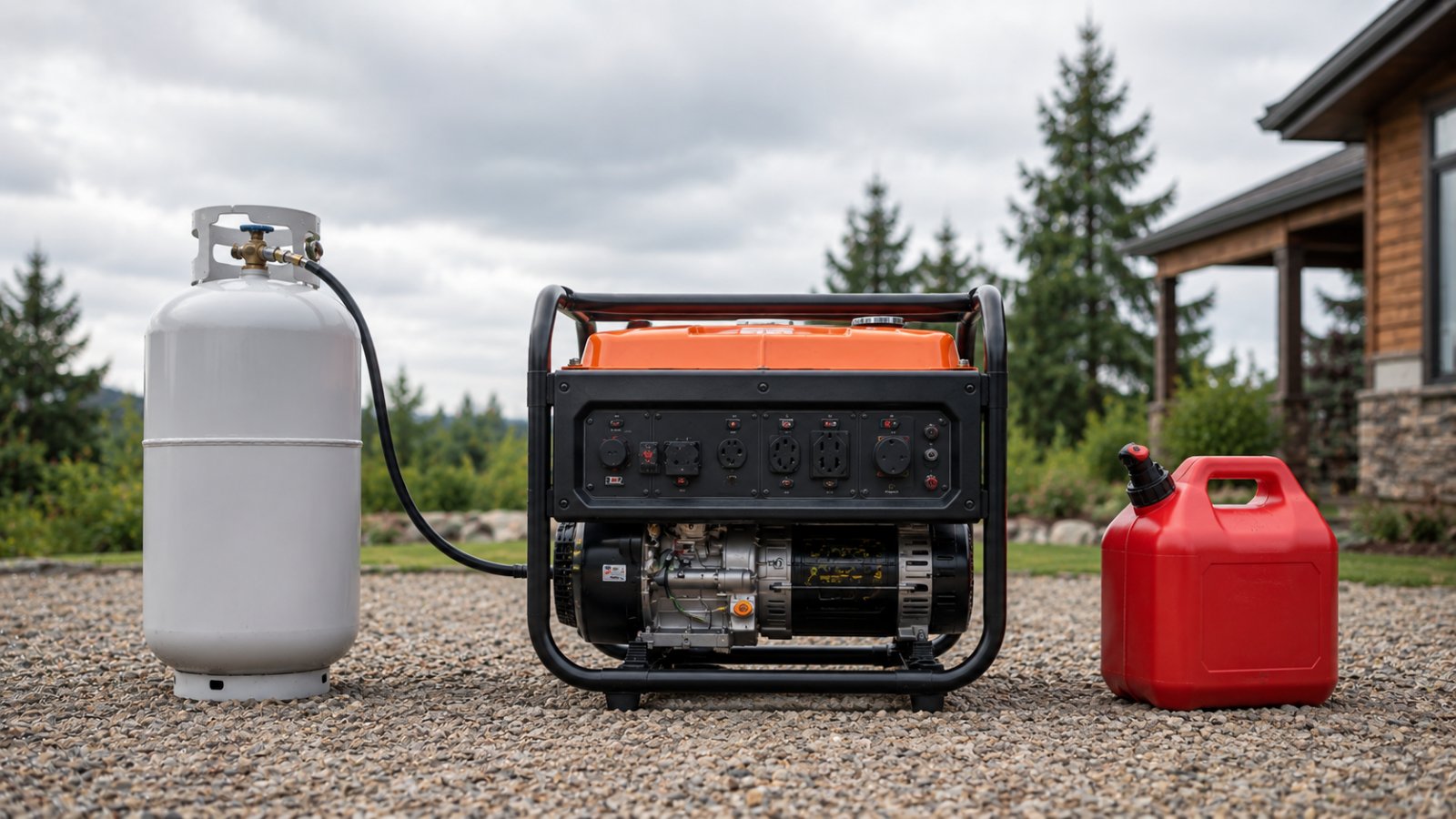
Propane vs Gas Generator: Pros, Cons and Cost
When you’re buying a generator, the fuel question matters more than most people realize: propane or gasoline? Each has real advantages and real drawbacks, and the right choice depends on how you’ll use the generator — everyday convenience, long-term emergency storage, maximum power, or cold-weather reliability. (And increasingly, the smartest answer is “both.”)
Here’s the honest propane vs gas generator comparison — pros, cons, and cost — so you can pick the right fuel for your situation.
Note: “Gas” here means gasoline. We also touch on natural gas, which is common for whole-house standby generators. All fuel generators must run outdoors only.
The quick verdict
- Gasoline wins on availability, portability, and slightly higher power output — convenient for everyday and portable use.
- Propane wins on storage life, clean burning, and emergency readiness — it stores for years and is ideal for a generator that sits until needed.
- Dual-fuel generators let you use both, and are often the best choice for home backup. See Best Dual-Fuel Generators of 2026.
Side-by-side comparison
|
Factor |
Gasoline |
Propane |
|---|---|---|
|
Availability |
Everywhere (gas stations) |
Common (tanks, exchanges) |
|
Shelf life |
3–6 months (degrades) |
Indefinite |
|
Power output |
Slightly higher |
~10% lower |
|
Cold-weather starting |
Good |
Can struggle in extreme cold |
|
Emissions |
Higher |
Cleaner burning |
|
Storage safety |
Flammable liquid |
Pressurized tank, stores safely |
|
Cost per hour |
Moderate |
Similar to slightly higher |
|
Best for |
Everyday, portable, max power |
Emergency standby, long storage |
Where gasoline wins
Availability. Gasoline is everywhere — every gas station has it, and you probably already keep some for the mower. In a pinch (as long as stations have power), it’s the easiest fuel to find.
Slightly higher power. Generators produce a bit more output on gasoline than propane — typically around 10% more — because gasoline is more energy-dense. If you need every last watt, gas delivers.
Convenience and portability. For a portable generator you move around — camping, tailgating, job sites — gasoline is simple: fill the tank and go, no bulky propane tank to lug.
Easier cold starts. Gasoline generators generally start more reliably in very cold weather than propane, which can lose pressure and struggle to vaporize in extreme cold.
The catch: gasoline degrades in months, gumming up carburetors, so it needs fuel stabilizer and rotation — a real hassle for a generator that sits unused between emergencies. And during a widespread outage, gas stations may be closed or mobbed.
Where propane wins
Indefinite storage. This is propane’s killer feature. It stores for years without degrading, so a propane generator is always ready — no stale fuel, no stabilizer, no rotation. For emergency backup that sits idle until a storm hits, this is a huge advantage.
Clean burning. Propane burns cleaner than gasoline, producing fewer emissions and less engine deposit buildup, which can mean easier maintenance and a longer engine life.
Emergency readiness. Because you can keep multiple full tanks on hand, you’re not dependent on finding fuel during an outage. Stockpile propane and you’re set for a long event.
Safer, cleaner storage. No spills, no fumes, no flammable-liquid storage concerns — just sealed pressurized tanks.
The catch: propane delivers slightly less power, can struggle to start in extreme cold, and you need to keep tanks on hand (and know your supply — you can’t siphon a bit from the car like gasoline).
A note on natural gas (for standby generators)
For whole-house standby generators, there’s a third option: natural gas, piped directly to your home. It’s the cheapest fuel to run, offers essentially unlimited runtime (no tank to refill), and requires no storage — which is why it’s the top choice for permanently installed standby units where a gas line is available. Its only downsides are that it’s tied to the gas grid (which can fail in rare cases) and delivers slightly less power than gasoline. For running costs by fuel, see How Much Does It Cost to Run a Whole-House Generator?.
Cost comparison
On a per-hour basis, running a generator on gasoline and propane costs roughly similar, with propane often slightly higher per unit of energy — but the real cost story is about use pattern, not just price:
- Gasoline can be cheaper per gallon but degrades, so fuel you buy and don’t use may be wasted.
- Propane costs a bit more per unit of energy but never spoils, so nothing is wasted in storage.
- Natural gas (standby only) is by far the cheapest to run.
For most homeowners, the fuel-cost difference between gas and propane is small enough that convenience, storage life, and readiness matter more than the per-hour price.
Which fuel should you choose?
Choose gasoline if: you want a portable generator for everyday, camping, or job-site use; you value maximum power and easy fuel availability; and you’ll use it often enough that fuel won’t go stale.
Choose propane if: you want emergency backup that sits ready for years; you value clean burning and safe, spoil-proof storage; and you can keep tanks on hand.
Choose natural gas if: you’re installing a whole-house standby generator and have a gas line — it’s the cheapest, most convenient fuel with unlimited runtime.
Choose dual-fuel (or tri-fuel) if: you want it all. A dual-fuel generator runs on gasoline or propane, giving you gasoline’s convenience and power plus propane’s storage and readiness — the best hedge for home backup, and our general recommendation. See Best Dual-Fuel Generators of 2026.
Cold-weather performance and safety
Two practical factors deserve extra attention when choosing a fuel. First, cold weather: gasoline generators generally start reliably in freezing temperatures, while propane can struggle in extreme cold, because propane must vaporize to burn and loses pressure as temperatures drop (roughly below -20°F, or higher with a nearly empty tank). If you live somewhere with brutal winters and rely on propane, keep tanks reasonably full and consider a tank warmer for the coldest snaps.
Second, safety: both fuels demand respect. Gasoline is a flammable liquid — store it in approved containers, away from living spaces and ignition sources, and never refuel a hot running generator. Propane is stored under pressure — keep tanks upright, outdoors, and check for leaks. And regardless of fuel, the cardinal rule stands: run any generator outdoors only, well away from windows and doors, because all of them produce deadly carbon monoxide. A CO detector in your home adds a critical layer of protection during generator use.
Limitations and who this isn’t for
Neither fuel is best for everyone: gasoline is widely available but degrades in storage and can be scarce in emergencies; propane stores for years and burns cleaner but usually yields slightly lower output and depends on tank supply. Cold weather affects both. The right choice depends on your storage, typical outage length and local fuel availability.
How we source this guide: capacities, runtimes and prices are drawn from manufacturer documentation and reputable public sources and can change. Always confirm current specifications and pricing on the manufacturer’s website before buying.
Frequently asked questions
Is a propane or gas generator better? It depends on use. Gasoline is better for everyday and portable use, availability, and slightly higher power. Propane is better for emergency backup, with indefinite storage life and clean burning. Dual-fuel generators offer both, making them ideal for home backup.
Does a generator produce less power on propane? Yes, typically about 10% less on propane than gasoline, because gasoline is more energy-dense. It’s a modest trade-off for propane’s storage and cleanliness benefits.
How long does propane last in storage vs gasoline? Propane stores indefinitely without degrading, while gasoline lasts only 3–6 months before it starts to break down (longer with stabilizer). This makes propane far better for a generator that sits unused between emergencies.
Is propane cheaper than gas for a generator? Per unit of energy, propane is often slightly more expensive than gasoline, but the difference is small. Natural gas (for standby generators) is much cheaper than both. Storage life and convenience usually matter more than the per-hour cost.
Should I get a dual-fuel generator? For home backup, usually yes. A dual-fuel generator lets you run on gasoline for convenience and power or propane for storage and readiness, so you’re never stranded by a fuel shortage — the most flexible choice for emergencies.
Does propane work in cold weather for generators? Propane can struggle in extreme cold (roughly below -20°F, or warmer with a low tank) because it must vaporize to burn and loses pressure as temperatures drop. Gasoline generally starts more reliably in freezing weather. Keep propane tanks full and consider a tank warmer in harsh winters.
Is it safe to store propane for a generator? Yes, when done correctly — keep tanks upright, outdoors, away from ignition sources, and check for leaks. Propane stores safely and indefinitely, which is one of its biggest advantages for emergency backup over gasoline.
The bottom line
Propane vs gas generator comes down to your use pattern. Gasoline offers convenience, availability, and a bit more power — great for portable, everyday use. Propane offers indefinite storage, clean burning, and emergency readiness — ideal for backup that sits until a storm hits. Natural gas is the cheapest, unlimited-runtime option for standby units on a gas line. And if you can’t decide, a dual-fuel generator gives you gasoline and propane in one machine — which, for most home-backup buyers, is the smartest choice of all.