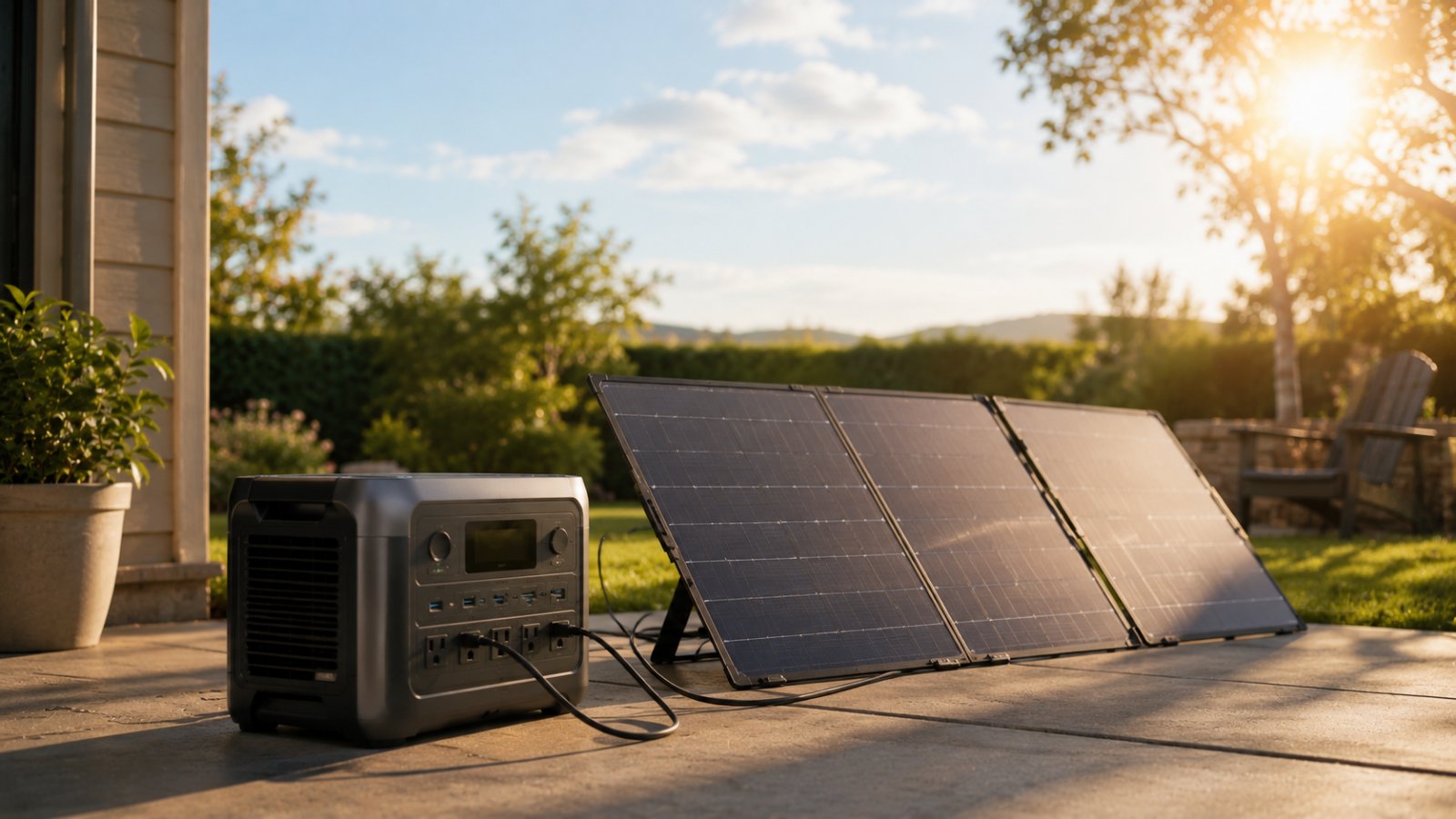
Best Solar Generators of 2026 for Home and Emergencies
When the grid goes down, a solar generator is the closest thing to magic in your garage: it keeps the lights on, the fridge cold, and the phones charged — silently, with no gas, no fumes, and no trips to a crowded fuel station. And because it refuels from the sun, it can keep going long after a gas generator would have run dry. For home backup and emergencies in 2026, nothing else offers this combination of quiet, safety, and renewable staying power.
A “solar generator” is simply a portable power station paired with solar panels, and the market has never been better. We’ve tested and lived with these systems through outages, storms, and off-grid stretches, and below are the ones worth your money this year — sorted by exactly who each one is for.
The short version: for most households, the EcoFlow Delta 2 solar generator delivers the best blend of power, fast charging, and value. Families wanting simple, grab-and-go reliability should look at the Jackery Solar Generator 1000 v2. And if you’re backing up an entire house, the Anker SOLIX F3800 is the powerhouse to beat.
Best solar generators at a glance
| Solar generator | Capacity | AC output | Recommended panels | Best for | Typical 2026 price |
|---|---|---|---|---|---|
| EcoFlow Delta 2 + 220W | 1,024 Wh | 1,800 W | 220–500 W | Best overall value | ~$700–$900 |
| Jackery Solar Generator 1000 v2 | 1,070 Wh | 1,500 W | 200–400 W | Best for most people | ~$999–$1,299 |
| Bluetti AC200L + PV350 | 2,048 Wh | 2,400 W | 350–1,200 W | Best mid-size/expandable | ~$1,700–$2,000 |
| Anker SOLIX F3800 + 400W | 3,840 Wh | 6,000 W (240V) | 400–2,400 W | Best whole-home | ~$3,300–$3,999 |
| EcoFlow River 3 Plus + 110W | 286 Wh | 600 W | 110–220 W | Best compact | ~$350–$450 |
Prices are approximate 2026 U.S. street prices for the station-plus-panel kit and drop during major sales.
How a solar generator works (the 30-second version)
A solar generator has two parts: a power station (a big LiFePO4 battery with an inverter and outlets) and one or more solar panels that recharge it. Sunlight hits the panels, a built-in charge controller feeds that energy into the battery, and the inverter turns it into standard household AC power for your devices. No fuel, no engine, no emissions — just a battery you can refill from the sky. For the full explainer, see What Is a Solar Generator and How Does It Work?.
How we picked
We evaluated every system on the specs that decide real-world performance:
Usable capacity and honest runtime. We favored LiFePO4 units (the 2026 standard — 3,000–4,000+ charge cycles) and weighed real-world output after inverter losses, not just the number on the box.
Output and surge. Continuous watts decide what you can run; surge watts decide whether your fridge’s compressor actually starts.
Solar input and charging speed. The higher a unit’s maximum solar input, the faster it refills from panels — and the more useful it is in a multi-day outage. We also prized fast AC charging, so you can top off before a storm hits.
Expandability and value. The best systems grow with you and don’t demand you pay MSRP. Every pick here regularly sells for less on sale.
The best solar generators of 2026
EcoFlow Delta 2 (+ 220W panel) — Best overall value
The Delta 2 is the solar generator we’d put in most homes. Its 1,024 Wh LiFePO4 battery and muscular 1,800 W inverter (2,700 W surge) run a full-size fridge, a microwave in bursts, CPAPs, laptops, and power tools, and it accepts up to 500 W of solar for quick daytime refills. Pair it with EcoFlow’s 220 W bifacial panel and you have a system that covers an evening-to-overnight outage on battery alone, then tops back up whenever the sun’s out. It also wall-charges to 80% in about 50 minutes — so you’re never caught with an empty battery before a storm. At its frequent sale prices, nothing matches its capability per dollar.
Best for: Households that want maximum power and fast charging without overspending.
Jackery Solar Generator 1000 v2 — Best for most people
Jackery built its reputation on making solar power foolproof, and this kit is the proof. The Explorer 1000 v2 (1,070 Wh, 1,500 W) is light at just 24.4 pounds, dead-simple to operate, and backed by a 4,000-cycle battery and a 5-year warranty. Bundled with SolarSaga panels that snap out and angle toward the sun in seconds, it’s the easiest grab-and-go emergency system on the market — the one we’d hand to someone who’s never owned a solar generator. It runs the essentials (fridge, lights, internet, devices) through most of a day and recharges cleanly from the sun.
Best for: First-timers and families who value simplicity and portability.
Bluetti AC200L (+ PV350) — Best mid-size and expandable
When you want more than a 1 kWh unit but not a whole-home behemoth, the AC200L is the answer. It ships with 2,048 Wh and a stout 2,400 W inverter, accepts a huge 1,200 W of solar (so it refills fast), and — crucially — expands to 8,192 Wh with add-on batteries. Paired with Bluetti’s PV350 panels, it becomes a serious off-grid and multi-day-outage system that grows with your needs. There’s even a built-in RV outlet for van and camper duty.
Best for: RVers, off-gridders, and homeowners who want a system they won’t outgrow.
Anker SOLIX F3800 (+ 400W panels) — Best whole-home
This is the one you buy to stop worrying about outages entirely. The F3800 delivers 3,840 Wh, a 6,000 W inverter, and — the key spec — 120V/240V split-phase output, so wired to your panel through a transfer switch it can run a well pump, furnace, or even a 240V appliance. It accepts a massive amount of solar and expands past 26 kWh with extra batteries, turning it into a genuine multi-day, whole-home solar backup system. Expensive and heavy, but nothing here matches its capability.
Best for: Homeowners planning serious, whole-house, multi-day backup.
EcoFlow River 3 Plus (+ 110W panel) — Best compact
Not every emergency needs a kilowatt-hour. At around 9 pounds, the River 3 Plus runs a 600 W inverter off a 286 Wh battery, keeping phones, laptops, a CPAP, lights, and small devices going through a night — and topping back up with a small 110 W panel. It’s the perfect apartment emergency kit, first solar generator, or ultralight camping companion, at a fraction of the price of the big systems.
Best for: Apartments, first-timers, and compact go-bags.
What to look for in a solar generator
Capacity (Wh) decides how long it runs — match it to what you need to power and for how long. Output (W) decides what it can run at once; for a home you want at least 1,500 W, and 240V if you need hard-wired appliances. Maximum solar input decides how fast it recharges from the sun — higher is better for outages. Panel wattage should be matched to that input to refill efficiently. And LiFePO4 chemistry is non-negotiable in 2026 for its long life. Our guide How to Size a Solar Generator for Your Home walks through the exact math.
Solar generator vs gas generator for emergencies
For anything you’d run indoors, a solar generator wins outright: it’s silent, emits nothing, needs no fuel, and turns on instantly. A gas generator still suits very long, days-long outages where you can run it outdoors and refuel continuously — but for the way most people experience emergencies, a solar generator is safer, quieter, and endlessly rechargeable from the sun. Many resilient homes keep both.
Matching a solar generator to your situation
The “best” solar generator depends entirely on where and how you’ll use it, so here’s a quick decision guide:
Apartment or condo: You can’t run a gas generator, which makes a solar generator the obvious (and only safe) choice. A compact-to-mid unit like the EcoFlow River 3 Plus or Delta 2 keeps the fridge, electronics, and devices alive, and a small folding panel on a balcony or by a sunny window tops it up.
House with occasional outages: A 1,000–2,000 Wh unit (EcoFlow Delta 3 Plus, Bluetti AC200L) covers essentials for a day, and 400–800 W of panels recharges it. Add a transfer switch only if you need hard-wired appliances.
RV or van life: Prioritize a unit with a built-in RV outlet and high solar input — the Bluetti AC200L is the favorite — so you can power the rig and recharge while you travel.
Off-grid cabin or homestead: Go big and expandable, with high solar input, like the AC200L, EcoFlow Delta Pro 3, or Anker SOLIX F3800, and size a real panel array to your daily use.
Nail down your scenario first, and the right unit almost picks itself.
Limitations and who this isn’t for
A solar generator is a battery power station plus panels — quiet and fuel-free, but its output is capped by battery size and how much sun you actually get. Cloudy days, short winter light and shade slash recharge speed, and panels rarely hit their rated watts in the real world. Great for essentials and off-grid top-ups, but not a replacement for a fuel generator when you need guaranteed high output for days.
How we source this guide: capacities, runtimes and prices are drawn from manufacturer documentation and reputable public sources and can change. Always confirm current specifications and pricing on the manufacturer’s website before buying.
Frequently asked questions
What is the best solar generator for 2026? For most homes, the EcoFlow Delta 2 kit offers the best mix of power, fast charging, and value. The Jackery Solar Generator 1000 v2 is the easiest pick for beginners, and the Anker SOLIX F3800 is the top choice for whole-home backup.
Can a solar generator power a house? Yes, with the right unit. Large split-phase systems like the Anker SOLIX F3800, wired through a transfer switch, can run whole-home loads including 240V appliances. Smaller 120V units back up essentials like the fridge, lights, and electronics.
How long does a solar generator last during an outage? It depends on capacity and sunlight. On battery alone, a 1,000 Wh unit runs essentials for most of a day and a 2,000 Wh unit for a day or more. With enough solar panels, it can recharge daily and effectively run indefinitely.
Are solar generators good for emergencies? Excellent. They’re silent, safe to run indoors (no carbon monoxide), need no stored fuel, and recharge from the sun — so they keep working in a prolonged outage when gas supplies run short.
Do solar generators come with panels? Some are sold as complete kits with panels included; others sell the power station and panels separately. See Best Solar Generator Kits With Panels Included for the best all-in-one bundles.
Do solar generators need maintenance? Almost none. There’s no engine, oil, or fuel — just a battery to keep charged. Store it partially charged, top it off every few months and before a storm, and a quality LiFePO4 unit lasts around a decade.
Can I run a solar generator while it’s charging from solar? Yes. You can use the outlets while panels recharge the battery — a “pass-through” setup that’s ideal for daytime off-grid use, where solar offsets your draw and banks the surplus.
How much does a good solar generator cost? Compact units start around $200–$400, mid-size home-backup kits run $700–$2,000, and whole-home 240V systems reach $3,000 and up. Prices drop significantly during major sales.
The bottom line
A solar generator is the smartest emergency-power buy of 2026 for most homes — silent, safe indoors, and rechargeable from the sky. Get the EcoFlow Delta 2 kit for the best all-around value, the Jackery Solar Generator 1000 v2 for plug-and-play simplicity, the Bluetti AC200L to scale up for off-grid or RV life, or the Anker SOLIX F3800 for true whole-home backup. Whichever you choose, buy on a sale and match your panels to the unit’s solar input — that’s how you get a system that’s ready for anything.