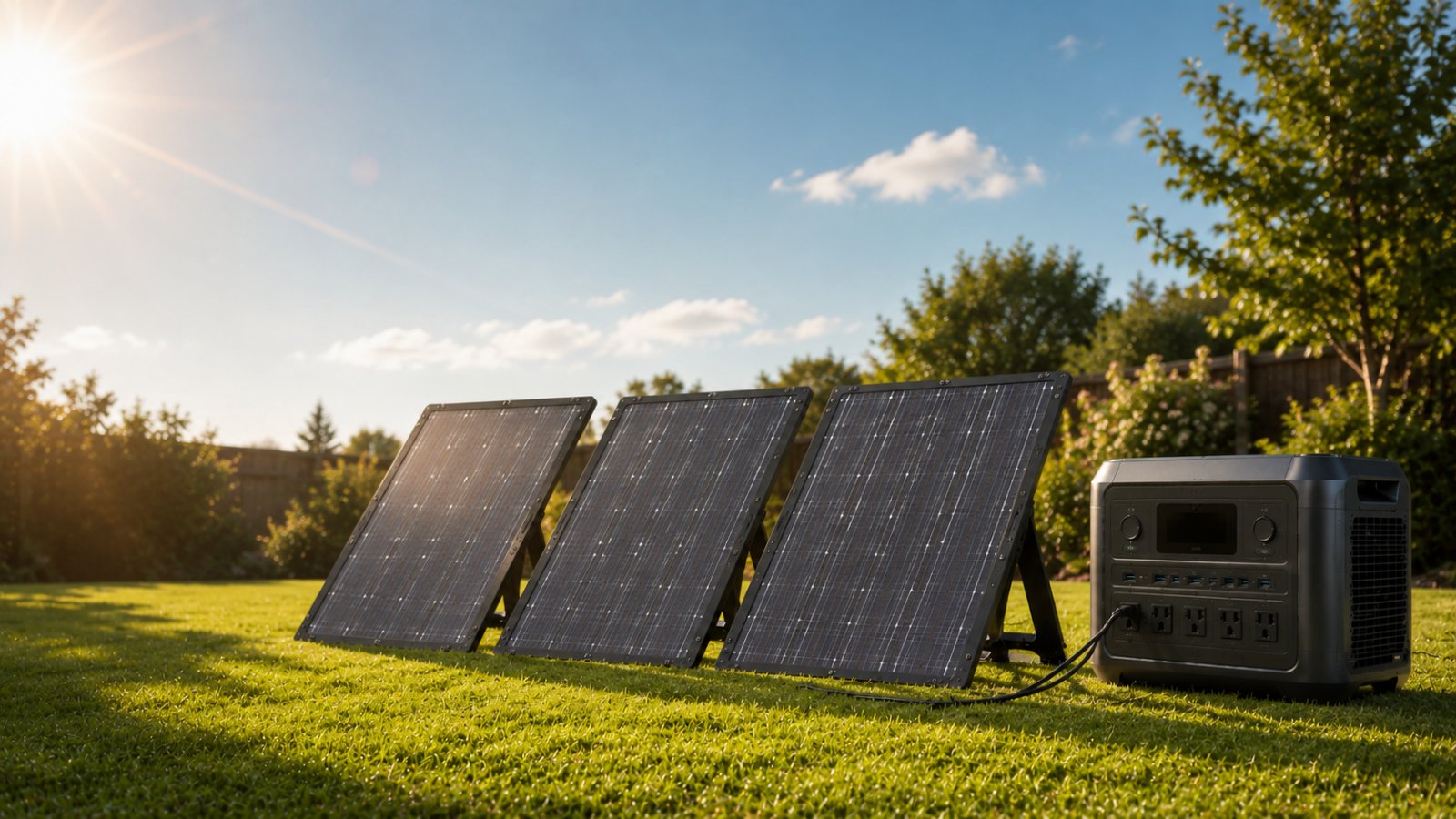
Best Portable Solar Panels for Power Stations in 2026
A power station is only half of a solar generator — the panels are the other half, and they’re what turn a battery that eventually dies into a system that recharges from the sky. Get the panel right and you can camp for weeks or ride out a multi-day outage; get it wrong and you’re stuck with a slow trickle that never keeps up.
The good news: portable solar panels in 2026 are lighter, more efficient, and more affordable than ever, and most brands’ panels play nicely with other brands’ stations if you have the right cable. Below are the best portable solar panels for power stations this year, sorted by size and use, plus a quick guide to matching a panel to your unit.
Quick picks: for all-around use, the EcoFlow 220W bifacial and Jackery SolarSaga 200W lead the pack. The Bluetti PV200 is the best value in a 200W panel, and the Anker SOLIX 400W is the best high-wattage option for big stations.
Best portable solar panels at a glance
| Solar panel | Wattage | Real-world output* | Weight | Best for | Typical 2026 price |
|---|---|---|---|---|---|
| Jackery SolarSaga 200W | 200 W | ~184 W | ~14 lb | Best overall | ~$500–$700 |
| EcoFlow 220W Bifacial | 220 W | ~200 W+ | ~21 lb | Best dual-sided | ~$400–$500 |
| Bluetti PV200 | 200 W | ~178 W | ~19 lb | Best value 200W | ~$450–$500 |
| Anker SOLIX 400W | 400 W | ~330 W | ~35 lb | Best high-wattage | ~$800–$900 |
| Jackery SolarSaga 100W | 100 W | ~90 W | ~11 lb | Best compact/budget | ~$150–$250 |
| Renogy 200W Foldable | 200 W | ~175 W | ~20 lb | Best budget/universal | ~$300–$400 |
Real-world output in good sun is always below the rated wattage due to heat, angle, and conditions — typically 80–92% of the rating for quality panels.
Why real-world output is always lower than the rating
Here’s something every buyer should know: a “200W” panel almost never delivers 200 watts. Rated wattage is measured under ideal lab conditions (STC), but in the real world, heat, sun angle, haze, and cable losses knock output down to roughly 80–92% of the rating even in good sun. The best panels — high-efficiency monocrystalline units — stay near the top of that range; cheaper panels drop lower. That’s why we list real-world output above, and why it’s smart to buy a bit more panel than the math suggests. Don’t expect a single 100W panel to fully recharge a 1,000 Wh station in a day; it won’t.
The best portable solar panels for power stations
Jackery SolarSaga 200W — Best overall
Jackery’s 200W SolarSaga is the panel we’d hand most people. It delivers among the best real-world output in its class (around 184W in full sun), folds down cleanly, sets up in seconds with integrated kickstands, and its monocrystalline cells are efficient and durable. It pairs perfectly with Jackery stations and works with other brands via adapter. It’s not the cheapest, but it’s the reliable, high-performing default.
Best for: Anyone wanting top real-world performance in a portable 200W panel.
EcoFlow 220W Bifacial — Best dual-sided
EcoFlow’s clever bifacial design captures sunlight on both sides — the front from direct sun, the back from reflected light off the ground — for a meaningful real-world boost over standard panels. It’s rugged, folds into a tidy case, and feeds EcoFlow’s stations (and others, with the right cable) efficiently. For campers and off-gridders who want to squeeze maximum energy out of each daylight hour, it’s a standout.
Best for: Maximizing daily harvest, especially over reflective surfaces.
Bluetti PV200 — Best value 200W
The PV200 is the value leader in the 200W class. It delivers strong real-world output (around 178W), uses efficient monocrystalline cells, and typically costs less than the Jackery and EcoFlow options while performing nearly as well. It pairs natively with Bluetti stations and works across brands with an adapter. If you want 200 watts without paying a premium, this is it.
Best for: Budget-conscious buyers who still want serious 200W output.
Anker SOLIX 400W — Best high-wattage
For big stations that accept a lot of solar, a single high-wattage panel beats juggling several small ones. Anker’s 400W folding panel delivers around 330W in good sun, sets up as one unit, and refills a 2 kWh station meaningfully faster than a 200W panel. It’s heavy at ~35 pounds and best for stationary or vehicle-based setups rather than backpacking, but for cabin, RV, and home-backup duty it’s the efficient choice.
Best for: Large stations and off-grid setups needing fast, high-wattage charging.
Jackery SolarSaga 100W — Best compact and budget
The 100W SolarSaga is the easy, affordable entry point. At around 11 pounds it’s genuinely portable, it sets up in seconds, and it’s plenty to keep a compact station (or phones, laptops, and a CPAP) topped up on a trip. Chain two together for a small station and you’ve got a capable weekend system. It’s the panel most first-timers should start with.
Best for: Compact stations, weekend trips, and first-time buyers.
Renogy 200W Foldable — Best budget and universal
Renogy has long been the value king in solar, and its 200W foldable panel carries that reputation: solid real-world output, rugged build, and a price that undercuts the big-brand panels. It uses standard MC4 connectors, so it works with virtually any power station that has a solar input and the right adapter — making it a great universal choice if you’re mixing brands. BougeRV panels are another strong budget option in the same vein.
Best for: Budget buyers and mixed-brand setups.
How to match a panel to your power station
Getting the pairing right comes down to three checks:
1. Watts: match panel wattage to the station’s maximum solar input. Every station lists a max solar input (e.g., 400W, 500W, 1,200W). Don’t exceed it — excess is wasted — and don’t undershoot it badly, or charging will crawl. Aim to get reasonably close to the input for fast refills.
2. Voltage and amperage: stay within the station’s window. The station’s charge controller accepts solar within a specific voltage (Voc) and amperage range, listed in its specs. A panel whose open-circuit voltage is too high can shut charging off or, worse, damage the input. Most brand-matched panels are safe by design; if mixing brands, check the numbers.
3. Connectors: get the right cable. Panels commonly use MC4 or XT60 connectors, while stations may use XT60, proprietary plugs, or Anderson connectors. An inexpensive adapter cable bridges almost any panel to any station — which is why brand-mixing is usually fine.
Our companion guide How Many Solar Panels to Charge a Solar Generator? walks through the full sizing math with worked examples.
Foldable vs rigid panels
Most portable solar panels are foldable — they collapse into a briefcase-sized package with a carrying handle and kickstands, ideal for camping, emergencies, and moving around to chase the sun. Rigid panels (like Renogy’s classic 100W boards) are cheaper per watt and more durable for permanent mounting on an RV roof or a cabin, but they’re not something you fold up and carry. For a solar generator you move around, foldable is almost always the right call; for a fixed installation, rigid saves money.
How to get the most from your panels
Even the best panel underperforms if you set it up carelessly, so a few habits make a real difference. Angle it directly at the sun — a panel tilted toward the sun can produce dramatically more than one lying flat, and repositioning it a couple of times a day meaningfully boosts your daily harvest. Avoid all shade, even partial: shadow across a single cell can crater a whole panel’s output, so keep it clear of tree branches, poles, and your own gear. Keep panels cool and clean — excess heat lowers efficiency, and dust, pollen, or bird droppings block light, so a quick wipe and good airflow help. And use short, appropriately gauged cables; long or thin cables lose energy to resistance. None of this is complicated, but together these habits can be the difference between a panel hitting 85% of its rating and limping along at 60%.
Limitations and who this isn’t for
Portable panels rarely hit their rated wattage in real conditions — angle, haze, heat and dust all cut output, so a 200W panel often delivers noticeably less. Compatibility matters too: connector type, voltage range and your power station’s maximum solar input all have to match. Buy for real-world output and compatibility, not the sticker watts.
How we source this guide: capacities, runtimes and prices are drawn from manufacturer documentation and reputable public sources and can change. Always confirm current specifications and pricing on the manufacturer’s website before buying.
Frequently asked questions
What are the best portable solar panels for a power station? The Jackery SolarSaga 200W and EcoFlow 220W Bifacial lead for all-around performance, the Bluetti PV200 is the best 200W value, and the Anker SOLIX 400W is the top high-wattage pick. Match the panel wattage to your station’s maximum solar input.
Can I use any solar panel with any power station? Usually yes, with the right adapter cable — as long as the panel’s voltage and amperage stay within the station’s solar input window. Brand-matched panels are guaranteed compatible; mixed-brand setups just need a compatible cable and a voltage check.
How many watts of solar panel do I need? Match your panels to the station’s maximum solar input and your daily energy needs. As a rule, 200W+ suits a 1,000 Wh station and 400W+ suits a 2,000 Wh station. More panel wattage means faster recharging.
Why does my solar panel produce less than its rated wattage? Rated wattage is measured in ideal lab conditions. In the real world, heat, sun angle, haze, and cable losses reduce output to roughly 80–92% of the rating even in good sun. Buying a bit more panel than the math suggests compensates for this.
Are foldable solar panels good? Yes — for portable use they’re ideal, folding into a carry case with built-in stands to angle at the sun. They’re the right choice for a solar generator you move around. Rigid panels are better only for permanent mounting.
How do I get maximum output from a portable solar panel? Angle it directly at the sun and reposition through the day, keep it completely out of shade, wipe off dust, and use short cables. These habits can add 20% or more to your real-world output.
Do portable solar panels work on cloudy days? Yes, but at reduced output — often 10–25% of rated wattage under heavy clouds. They still trickle-charge, but you’ll bank far less energy, which is why oversizing panels and battery helps for unreliable weather.
How long do portable solar panels last? Quality monocrystalline panels last 20–25+ years, far longer than the power station’s battery. They’re a long-term investment that will outlive several batteries.
The bottom line
The right panel turns your power station into a true solar generator. For most people, the Jackery SolarSaga 200W or EcoFlow 220W Bifacial deliver the best real-world performance; the Bluetti PV200 is the value pick; and the Anker SOLIX 400W is the one for big stations. Match the panel’s wattage and voltage to your unit’s solar input, grab the right cable, and buy a little more panel than the math suggests — real-world sun is never as generous as the spec sheet.