Power Station Buying Guide: Everything You Need to Know (2026)
Shopping for a portable power station can feel like decoding a foreign language: watt-hours, surge watts, LiFePO4, MPPT, pass-through charging. But once you understand a handful of specs, choosing the right unit is genuinely simple. This guide breaks down everything you need to know to buy the right power station in 2026 — no jargon left unexplained, no marketing fluff.
The one-sentence version: match a unit’s capacity (watt-hours) to how long you need to run things, its output (watts) to what you’ll run at once, insist on a LiFePO4 battery, and pick the features (fast charging, solar input, expandability) that fit your use.
What is a portable power station?
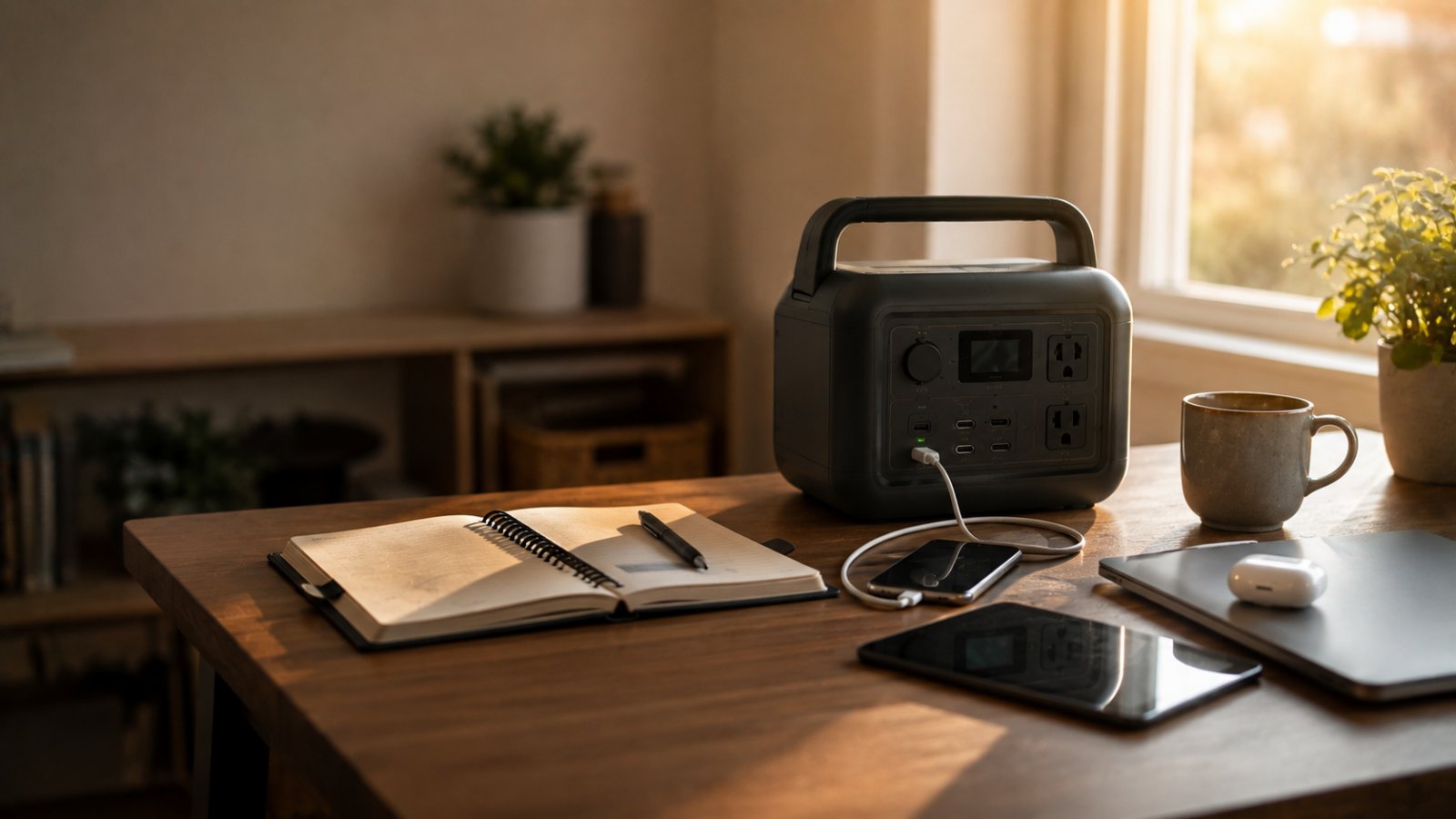
A portable power station is a large rechargeable battery with an inverter and outlets — essentially a giant, silent power bank that can run household devices. Unlike a gas generator, it produces no fumes or noise, so you can use it indoors, and it recharges from a wall outlet, a car, or solar panels. People use them for camping, RV trips, home backup during outages, job sites, and powering medical devices.
If you want the concept explained from scratch, see What Is a Solar Generator and How Does It Work? (a solar generator is just a power station plus panels).
The specs that actually matter
Here are the numbers and features to understand, in order of importance.
1. Capacity (watt-hours, Wh) — how long it runs
This is the size of the battery’s “fuel tank.” A 1,000 Wh unit holds 1,000 watt-hours of energy — enough to run a 100-watt device for roughly 10 hours (minus losses). More watt-hours means longer runtime. Match capacity to what you need to power and for how long. Our guide Watt-Hours Explained covers this in depth.
2. Output (watts, W) — what it can run at once
The inverter’s continuous wattage rating tells you the maximum power you can draw at any moment. It must exceed the combined draw of everything you plug in simultaneously. Just as important is the surge (or peak) watts — the brief spike when motors start (fridges, pumps, power tools). If a unit’s output is below your appliance’s draw, it simply won’t run it.
3. Battery chemistry — insist on LiFePO4
In 2026, the standard is LiFePO4 (lithium iron phosphate), and for good reason: it lasts 3,000–4,000+ charge cycles (roughly a decade), versus about 500 for older NMC lithium. It’s also safer and handles heat better. Avoid units still using older lithium chemistry unless the price is very low and longevity doesn’t matter. See LiFePO4 vs Lithium-Ion for the full comparison.
4. Recharge speed and options
Look at how fast it charges from the wall (the best units hit 80% in under an hour), and what other options it supports: solar input (with the max wattage it accepts), car charging, and pass-through (using it while it charges). Fast charging matters more than people expect — it’s the difference between being ready for a storm and missing the window.
5. Solar input
If you’ll use it off-grid or for multi-day outages, check the maximum solar input (in watts) and whether it has an MPPT controller (which maximizes solar harvest). Higher solar input means faster recharging from panels.
6. Ports
Count the outlets you need: AC outlets (and whether they’re pure sine wave — they should be), USB-A, USB-C (and its wattage, ideally 100 W for laptops), a 12V car port, and any specialty outputs like a 30A RV outlet. More ports mean fewer power strips.
7. Expandability
If your needs might grow, buy into a platform that lets you add expansion batteries later. It’s far cheaper than buying a second unit.
8. UPS / switchover
For backup use, a UPS mode lets the unit take over instantly (in milliseconds) when the grid fails, so devices like a fridge or computer never blink off. Look for switchover times under ~20 ms.
9. Weight and portability
Capacity and weight go hand in hand. If you’ll carry it (camping, tailgating), prioritize a lighter unit; if it lives in one place for backup, weight matters less.
How to choose by use case
Camping and travel: Prioritize light weight and portability. A 300–1,000 Wh unit covers most trips. See Best Portable Power Station for Camping and RV.
Home backup (essentials): Prioritize output (1,500 W+) and enough capacity for your fridge and devices — 1,000–2,000 Wh, ideally expandable. See Best Portable Power Station for Home Backup.
Medical devices: Prioritize clean power (pure sine wave), quiet operation, UPS mode, and enough runtime. See Best Backup Power Options for Medical Devices at Home.
Off-grid / RV: Prioritize high capacity, expandability, high solar input, and possibly an RV outlet. See Best Solar Generator for Off-Grid Cabins.
Budget / first unit: A compact LiFePO4 unit under $500 covers essentials. See Best Budget Portable Power Station Under $500.
To calculate exactly what size you need, use What Size Power Station Do I Need?.
The main brands
Four brands dominate in 2026, each with strengths: Jackery (lightweight, simple), EcoFlow (fast charging, best app, strong output), Bluetti (capacity, expandability, value), and Anker SOLIX (build quality, value). All make reliable LiFePO4 units with 5-year warranties. Our EcoFlow vs Jackery vs Bluetti comparison breaks down the differences.
What should you spend?
Rough 2026 price ranges: compact units (250–500 Wh) run $150–$400; mid-size (1,000 Wh) run $400–$800; large (2,000 Wh) run $1,000–$1,500; and expandable whole-home-class units run $2,000+. Prices drop 30–50% during major sales — see Best Time of Year to Buy a Power Station.
Buying tips
Buy on a sale. Discounts are deep and frequent (Prime Day, Black Friday). Rarely pay full MSRP.
Don’t overbuy or underbuy. Size to your actual needs — calculate first.
Insist on LiFePO4 for anything you’ll use regularly.
Buy expandable if there’s any chance your needs grow.
Check the real usable capacity, not just the headline number (you get ~85% after losses).
Read the surge rating if you’ll run motors like a fridge or pump.
Common mistakes to avoid
A few errors trip up first-time buyers — sidestep these and you’ll buy smart:
Buying on capacity alone. A huge battery with a weak inverter still can’t start your fridge. Always check the output watts and surge, not just the watt-hours.
Ignoring the surge rating. Motors (fridges, pumps, power tools) spike at startup. If the surge rating is too low, the appliance won’t run, no matter the capacity.
Paying full MSRP. Power stations are discounted 30–50% during sales. Buying at list price means overpaying by hundreds — time your purchase (see Best Time of Year to Buy a Power Station).
Overbuying or underbuying. Calculate your real needs first. A unit that’s too small dies fast; one that’s too big wastes money and weight.
Settling for old chemistry. If a cheap unit still uses NMC lithium-ion, its short lifespan usually isn’t worth the savings. Hold out for LiFePO4.
Forgetting expandability. If your needs might grow, a non-expandable unit means buying twice. Buy into a platform you can add batteries to.
Limitations and who this isn’t for
A buying guide gives you the framework, but the right unit depends on your specific loads, budget and how you will recharge — there is no universal best. Specs and prices change constantly, and headline capacity means little if the output or recharge options don’t match your needs. Use this to shortlist, then confirm current specs, warranty and real usable capacity before buying.
How we source this guide: capacities, runtimes and prices are drawn from manufacturer documentation and reputable public sources and can change. Always confirm current specifications and pricing on the manufacturer’s website before buying.
Frequently asked questions
How do I choose a portable power station? Match its capacity (watt-hours) to how long you need to run things, its output (watts) to what you’ll run at once, and insist on a LiFePO4 battery. Then pick features — fast charging, solar input, expandability, UPS — that fit your use, and buy on a sale.
What size power station should I buy? It depends on your needs: 300–500 Wh for camping and small devices, 1,000–2,000 Wh for home backup with a fridge, and more for off-grid or whole-home use. Calculate by adding your devices’ watts times the hours you need.
What’s the most important spec on a power station? Capacity (watt-hours) determines runtime and output (watts) determines what you can run at once — both matter. Battery chemistry (LiFePO4) is the third essential, for long lifespan. Match all three to your needs.
What does LiFePO4 mean and does it matter? LiFePO4 (lithium iron phosphate) is a battery chemistry rated for 3,000–4,000+ charge cycles — about a decade of use — versus ~500 for older lithium. It’s safer and longer-lasting, and it’s the standard to insist on in 2026.
How much should I spend on a power station? Compact units run $150–$400, mid-size (1,000 Wh) $400–$800, and large (2,000 Wh) $1,000–$1,500, with whole-home units above $2,000. Sales cut these by 30–50%, so timing your purchase saves real money.
Is it worth buying a power station? For most people, yes — it provides silent, safe, fume-free backup power for outages, camping, and emergencies, and a quality LiFePO4 unit lasts a decade. Match it to your needs and buy on a sale for the best value.
What brand of power station is best? Jackery (lightweight, simple), EcoFlow (fast charging, best app), Bluetti (capacity, value), and Anker SOLIX (build quality) are the top brands, all making reliable LiFePO4 units with 5-year warranties. The best one depends on whether you prioritize portability, power, or value.
The bottom line
Buying the right power station comes down to understanding a few specs: capacity (how long it runs), output (what it runs at once), and chemistry (LiFePO4 for longevity), then layering on the features — fast charging, solar input, expandability, UPS — that match how you’ll use it. Calculate your needs first so you don’t over- or under-buy, choose a reputable brand, and time your purchase for a sale. Do that, and you’ll get a unit that quietly, reliably powers your life through outages and adventures for the next decade.