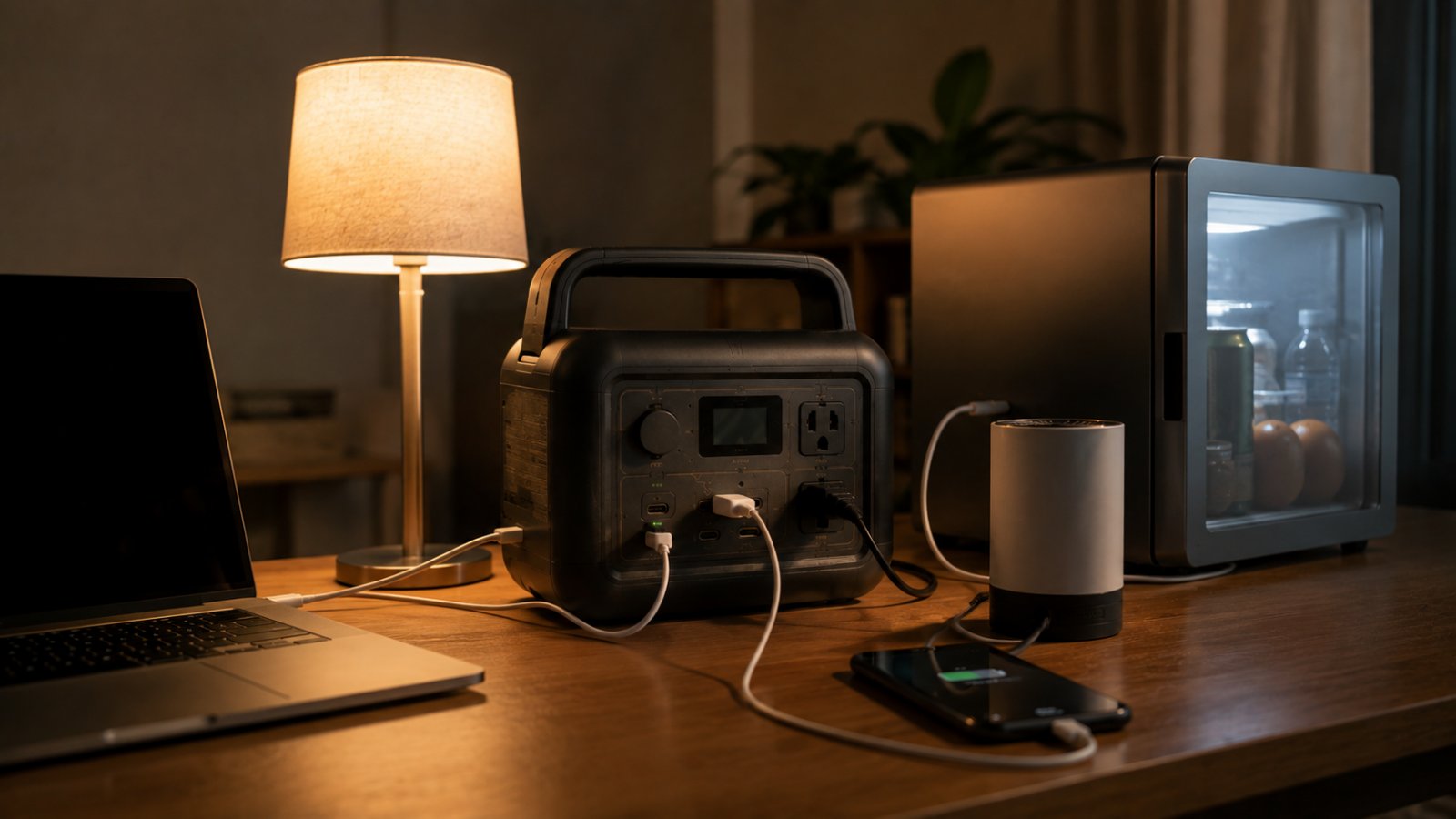
Power Station Wattage Calculator: What Can It Run?
Quick answer: what a power station can run depends on two specs — its output (watts) determines what you can run at once, and its capacity (watt-hours) determines how long. A device runs if its wattage is below the unit’s output rating; how long it runs equals the capacity (Wh) divided by the device’s watts (times ~0.85 for real-world losses). Below, we show exactly what common power station sizes can run and for how long.
Use this as your “calculator”: find your unit’s size (or the device you want to run), and the tables tell you what’s possible. (Publishing note: an interactive calculator widget on the live page would boost engagement — the tables and formula here are the logic behind one.)
The two rules that decide what runs
Rule 1 — Can it run this device? Check the watts. A power station can run any device whose power draw (in watts) is at or below its output rating, including the startup surge for motors. A 1,000-watt unit runs anything up to ~1,000 watts continuously; try to run a 1,500-watt heater and it won’t work.
Rule 2 — How long will it run? Check the watt-hours. Runtime = capacity (Wh) ÷ device watts × 0.85. A 1,000 Wh unit runs a 100-watt device for about 8.5 hours.
Both rules apply together: the device must fit within the output (watts), and the runtime depends on capacity (watt-hours). See Watt-Hours Explained for the full concept.
What can each power station size run?
Here’s a practical “calculator” by unit size, showing what it can power and rough runtimes (assuming ~85% usable capacity):
300 Wh power station (compact)
|
Device |
Runtime |
|---|---|
|
Phone (10 W) |
~25 charges |
|
Laptop (60 W) |
~4 hours |
|
CPAP (40 W) |
~6 hours (one night) |
|
Mini-fridge (50 W) |
~5 hours |
|
LED lights (20 W) |
~12 hours |
Can’t run: microwaves, heaters, most full-size appliances (output too low).
500 Wh power station
|
Device |
Runtime |
|---|---|
|
Laptop (60 W) |
~7 hours |
|
CPAP (40 W) |
~10 hours |
|
Mini-fridge (50 W) |
~8 hours |
|
TV (100 W) |
~4 hours |
|
Small blender (300 W) |
short bursts |
1,000 Wh power station (most popular)
|
Device |
Runtime |
|---|---|
|
Full-size fridge (60 W avg) |
~14 hours |
|
CPAP (40 W) |
~21 hours (2–3 nights) |
|
Laptop (60 W) |
~14 hours |
|
TV (100 W) |
~8.5 hours |
|
Microwave (1,000 W) |
~50 minutes |
|
Coffee maker (1,000 W) |
a few brews |
With ~1,800 W output, runs a fridge, microwave (in bursts), and most home devices.
2,000 Wh power station
|
Device |
Runtime |
|---|---|
|
Full-size fridge (60 W avg) |
~28 hours |
|
CPAP (40 W) |
4–6 nights |
|
Space heater (1,500 W) |
~1 hour |
|
Circular saw (1,400 W) |
intermittent use |
|
Multiple devices at once |
a full day of essentials |
With ~2,400 W output, handles heavier appliances and multiple loads simultaneously.
The reverse calculation: what size do I need for a device?
Flip it around — start with the device and find the unit:
|
I want to run… |
Minimum output |
Capacity for meaningful runtime |
|---|---|---|
|
Phones, laptop, lights |
300 W |
300–500 Wh |
|
CPAP overnight |
300 W |
500–1,000 Wh |
|
Full-size fridge |
1,500 W (for surge) |
1,000–2,000 Wh |
|
Microwave / coffee maker |
1,500 W |
1,000 Wh+ |
|
Space heater |
1,800 W |
2,000 Wh+ (short runtime) |
|
Power tools |
1,800–2,400 W |
1,000–2,000 Wh |
|
Fridge + several essentials |
2,400 W |
2,000 Wh+ (or expandable) |
Remember the surge: appliances with motors (fridges, pumps, saws) spike at startup — often 2–3× their running watts — so your unit’s surge rating must cover it, even if the running watts are lower.
The formula, so you can calculate any device
For any device and any unit:
Can it run it? Device running watts (and surge) ≤ unit’s output rating.
How long? Runtime (hours) = Capacity (Wh) × 0.85 ÷ Device watts.
Example: A 1,024 Wh unit running a 100-watt TV: 1,024 × 0.85 ÷ 100 ≈ 8.7 hours.
For sizing a whole home rather than a single device, see How to Calculate Your Home’s Backup Power Needs and What Size Power Station Do I Need?.
What a power station can’t run (and why)
Just as useful as knowing what a power station can run is understanding its limits. Two things cap what any unit will power:
High-wattage heating appliances, for long. Space heaters, hair dryers, electric kettles, and toasters draw 1,000–1,800 watts continuously and will drain even a large battery in under an hour — and may exceed a smaller unit’s output entirely. A power station can run them briefly, but they’re the fastest way to empty it.
Big 240V appliances. Standard power stations output 120V, so they can’t run hard-wired 240V appliances like a central AC, electric dryer, or well pump. Only large units with 240V split-phase output (like the EcoFlow Delta Pro series) can handle those.
The pattern to remember: power stations excel at electronics and intermittent appliances, but anything that heats or runs on 240V is either off-limits or a fast battery-drainer. Size up (or choose a 240V unit) if those are on your must-run list.
Limitations and who this isn’t for
Any what-can-it-run figure is an estimate: it assumes ideal conditions and usable (not nominal) capacity, and it ignores the surge spikes that can trip a unit when a motor starts. Simultaneous loads, cold weather and battery age all shorten real runtime. Use the numbers to compare, then leave headroom rather than planning to the last watt-hour.
How we source this guide: capacities, runtimes and prices are drawn from manufacturer documentation and reputable public sources and can change. Always confirm current specifications and pricing on the manufacturer’s website before buying.
Frequently asked questions
What can a 1,000W power station run? A 1,000 Wh unit (typically ~1,800 W output) can run a full-size fridge (~14 hours), a CPAP for 2–3 nights, laptops and TVs for many hours, and a microwave or coffee maker in short bursts. It handles most home essentials, though not high-wattage heaters for long.
How do I know what my power station can run? Check two specs: the output (watts) must be higher than your device’s draw, including startup surge, for it to run at all; and the capacity (watt-hours) divided by the device’s watts (times 0.85) tells you how long it will run.
What will a 2,000W power station run? A 2,000 Wh unit (usually ~2,400 W output) runs a fridge for a day-plus, powers heavier appliances like space heaters or power tools, and can run multiple devices at once — enough for a full day of home essentials.
How long will a power station run my fridge? A 1,000 Wh unit runs a typical fridge about 14 hours; a 2,000 Wh unit about 28 hours, because fridges cycle on and off so their average draw is low. You need at least ~1,500 W output to handle the fridge’s startup surge.
How do I calculate power station runtime? Divide the unit’s watt-hours by your device’s watts, then multiply by about 0.85 for real-world losses. For example, a 1,000 Wh unit running a 60-watt device: 1,000 × 0.85 ÷ 60 ≈ 14 hours.
The bottom line
Figuring out what a power station can run is a two-part question: output (watts) decides whether a device will run at all, and capacity (watt-hours) decides for how long. Use the tables above as your calculator, or apply the formula — runtime = capacity × 0.85 ÷ device watts — to any device. Match the output to your biggest load (including surge) and the capacity to your desired runtime, and you’ll know exactly what any power station can and can’t do before you buy.