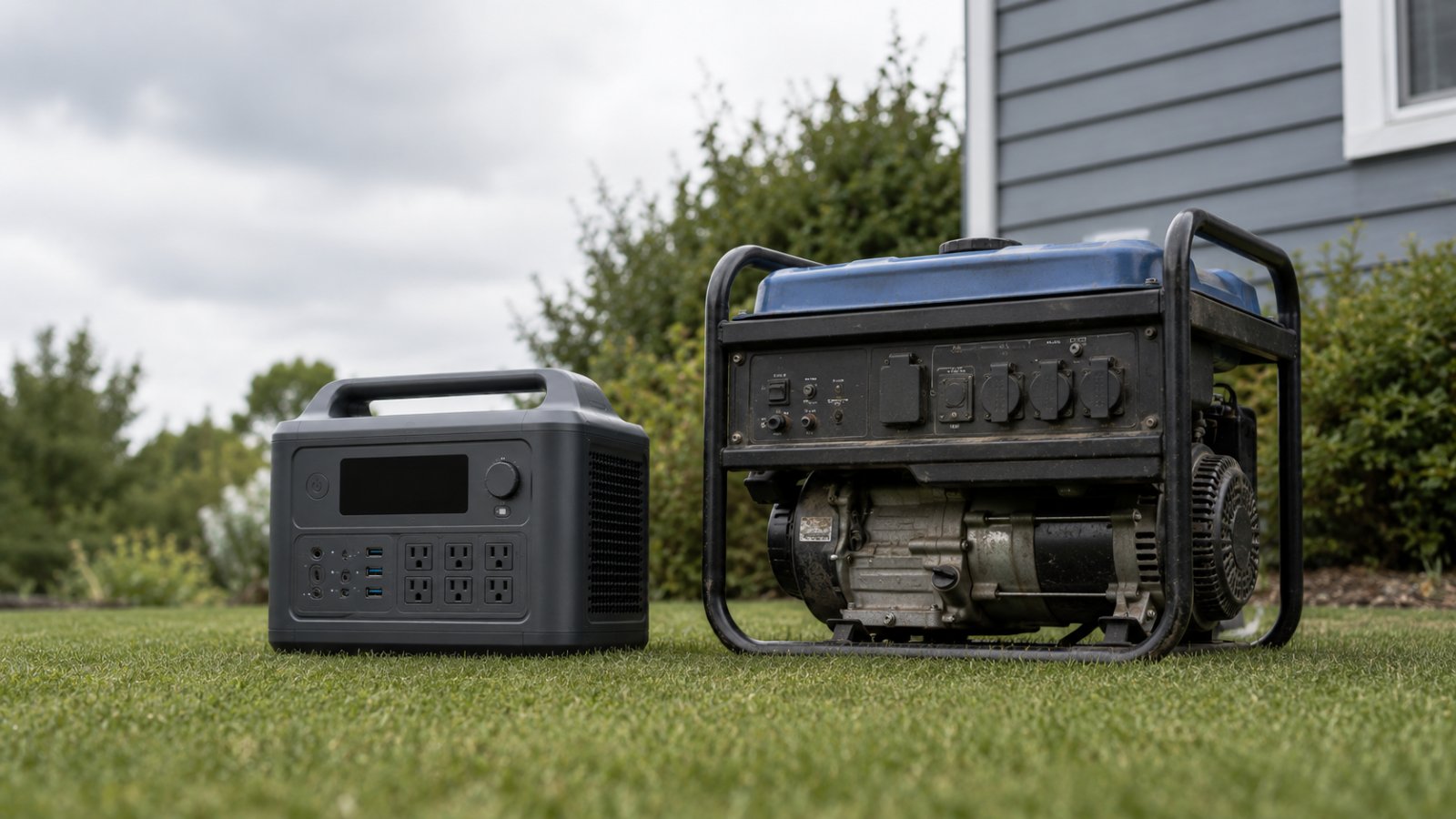
Portable Power Station vs Gas Generator: Which Should You Buy?
For decades, “backup power” meant one thing: a gas generator in the garage and a can of fuel beside it. Then portable power stations — big rechargeable batteries with AC outlets — showed up and changed the conversation. Now the most common question we get is simple: should I buy a portable power station or a gas generator?
The answer depends on what you’re protecting against. Here’s the full comparison for 2026, so you can pick the right tool instead of the loud, smelly default.
The quick verdict
Portable power station wins for most people: silent, safe indoors, zero fuel, instant-on, near-zero maintenance. Perfect for essentials backup, camping, and outages up to a day or two.
Gas generator wins for long, multi-day outages and heavy continuous loads, where you need to generate power for days and can run the unit safely outdoors.
The best setup for outage-country homes is often both — a battery unit for silent, automatic, indoor-safe backup, with a generator as a fuel-fed backstop for extended events.
Side-by-side comparison
| Factor | Portable Power Station | Gas Generator |
|---|---|---|
| Noise | Silent to a quiet hum | Loud (60–75+ dB) |
| Emissions | None | Carbon monoxide + exhaust |
| Safe indoors? | Yes | No — outdoors only |
| Fuel | None (recharge from wall/solar/car) | Gasoline (store & refill) |
| Runtime | Limited by battery size | As long as you have fuel |
| Refueling | Recharge (or add solar) | Add gas anytime |
| Startup | Instant, automatic (UPS mode) | Manual pull/electric start |
| Maintenance | Almost none | Oil changes, spark plugs, fuel care |
| Upfront cost | $$ ($200–$3,000+) | $ ($400–$1,200 typical) |
| Running cost | Pennies (electricity) | Ongoing fuel cost |
| Cold weather | Works (keep battery above freezing) | Works, but harder to start |
| Best for | Essentials, indoors, camping, short-mid outages | Long outages, heavy loads, job sites |
Where portable power stations win
Silence. This is the one everyone underestimates until they’ve lived it. A power station makes no more noise than a laptop. A gas generator drones loudly enough to annoy the whole street — and to make conversation on your own porch difficult.
Indoor safety. Gas generators produce carbon monoxide and must run outdoors, well away from windows. Every year, people are hospitalized or killed running them too close to the house. A battery power station emits nothing, so you can run it in your living room, bedroom, tent, or van without a second thought.
No fuel, no fumes, no storage. No gas cans in the garage, no stale fuel, no trips to the station during an emergency when everyone else is also lining up. You recharge from the wall before a storm, or from solar during one.
Instant, automatic backup. With UPS mode, a power station switches from grid to battery in milliseconds. Your fridge, Wi-Fi, and medical devices never blink. A generator, by contrast, has to be started and connected after the power’s already out.
Near-zero maintenance. No oil changes, no spark plugs, no carburetor gumming up because you didn’t run it for six months. Charge it occasionally and it’s ready for years.
Clean power for electronics. Power stations deliver pure sine wave AC that’s safe for laptops, phones, and sensitive medical gear. Cheaper generators can produce “dirtier” power that some electronics dislike.
Where gas generators still win
Unlimited runtime (with fuel). This is the big one. A battery holds a fixed amount of energy; when it’s empty, you recharge — which takes time and a power source. A generator runs as long as you keep feeding it gas. For an outage that lasts three, five, or seven days, that matters enormously.
Heavy, continuous, high-wattage loads. Large gas generators (7,000–12,000+ starting watts) can run central air conditioning, well pumps, and multiple large appliances at once, for hours on end. Battery units can do this too, but only the big, expensive whole-home models — and they’ll drain faster.
Lower upfront cost for high output. Dollar for watt, a gas generator is cheaper to buy. A $600 generator can output more raw wattage than a $600 power station. You pay for that later in fuel and noise, but the sticker price is friendlier.
No recharge anxiety in extended events. As long as fuel is available, a generator keeps going indefinitely. A power station in a week-long outage needs a robust solar setup to stay useful past its first charge.
The 5-year cost comparison
Sticker price only tells part of the story. Take a mid-size example over five years. A $600 gas generator burns fuel every time it runs — figure a few gallons a day during outages, plus oil changes and the occasional carburetor cleaning; over five years of semi-regular use, fuel and upkeep can easily add several hundred dollars. A comparable battery power station costs more upfront (say $1,000–$1,500) but runs on cents of electricity, needs no maintenance, and — with a LiFePO4 pack rated for thousands of cycles — is still going strong at the five-year mark. Add solar and its running cost during outages drops to essentially zero.
The takeaway: gas is cheaper to buy and more expensive to own; a power station is the reverse. The longer your horizon and the more you value zero-maintenance readiness, the better the battery unit looks.
What about a dual-fuel or propane generator?
Worth a mention: propane and dual-fuel generators solve some of gasoline’s problems — propane stores indefinitely without going stale and burns cleaner. They make a strong long-outage backstop. But they still can’t run indoors, still make noise, and still need maintenance. Many resilient setups pair a silent battery unit for everyday, indoor-safe backup with a propane generator held in reserve for multi-day events.
The honest recommendation by scenario
You want silent, safe, mostly-hands-off backup for essentials (fridge, lights, internet, CPAP, phones): Get a portable power station. This describes the majority of homeowners, and a 1,000–2,000 Wh unit covers it beautifully. See Best Portable Power Station for Home Backup.
You camp, tailgate, or want power where generators are banned: Power station, no contest — it’s silent and welcome where gas units aren’t.
You face frequent, multi-day outages and need to run big appliances continuously: A gas generator (or a dual-fuel/propane model) still makes sense as your workhorse — ideally paired with a battery unit for the silent, indoor-safe first line of defense.
You want the best of both: Buy a power station for daily/first-response backup and keep a generator as a fuel-fed backstop for the rare long event. Many outage-country households land here, and it’s genuinely the most resilient setup.
You want backup but hate maintenance and noise, and outages in your area are short: Power station, easily.
What about solar generators?
“Solar generator” is just a marketing term for a portable power station paired with solar panels. It’s not a separate category — it’s a power station that can recharge from the sun. Adding solar is what lets a battery unit rival a generator’s endurance in a long outage: each sunny day banks more energy, so you’re not limited to a single charge. If you’re leaning battery but worried about multi-day events, solar is the bridge.
Limitations and who this isn’t for
Neither is universally better. Power stations are silent, emission-free and safe indoors but limited by battery capacity and pricier per watt. Gas generators run as long as you have fuel and cost less up front, but are noisy, need fuel and maintenance, and must never run indoors or in a garage. Your outage length, budget and tolerance for noise and fuel decide the winner.
How we source this guide: capacities, runtimes and prices are drawn from manufacturer documentation and reputable public sources and can change. Always confirm current specifications and pricing on the manufacturer’s website before buying.
Frequently asked questions
Is a portable power station better than a gas generator? For most people, yes — it’s silent, safe to run indoors, needs no fuel, starts automatically, and requires almost no maintenance. Gas generators remain better for very long, multi-day outages and heavy continuous loads where unlimited runtime matters.
Can a power station replace a generator? For essentials backup, camping, and short-to-medium outages, absolutely. For days-long outages running large appliances continuously, a battery unit needs a big capacity and solar to compete — otherwise a generator is more practical.
Are portable power stations safe to use indoors? Yes. Unlike gas generators, they produce no exhaust or carbon monoxide, so they’re designed to run indoors, in tents, and in vehicles. Gas generators must always run outdoors.
Which is cheaper, a power station or a generator? A gas generator is cheaper upfront per watt of output, but costs more over time in fuel and maintenance. A power station costs more upfront but runs on cheap electricity (or free solar) with virtually no upkeep.
Do power stations work in winter? Yes, though lithium batteries perform best above freezing — keep the unit reasonably warm for full capacity. Gas generators run in cold too, but can be harder to start.
How much does it cost to run a power station vs a generator? A power station costs cents of electricity (or nothing, on solar) to recharge and needs no maintenance. A gas generator has ongoing fuel costs plus oil and upkeep — cheaper to buy, but more expensive to own over time.
Can a power station and generator be used together? Yes, and it’s a great strategy. Use the silent, indoor-safe battery unit for everyday and first-response backup, and keep a generator — ideally propane or dual-fuel — in reserve to recharge the battery and carry heavy loads during long outages.
Do power stations lose charge sitting in storage? Very slowly. LiFePO4 units hold charge well for months; just top them off periodically and before any forecasted storm so they’re ready when you need them.
The bottom line
For the way most people actually experience outages — a few hours to a day, wanting the fridge, Wi-Fi, and phones to stay alive without noise or fumes — a portable power station is the better buy in 2026. It’s silent, safe indoors, and effortless. A gas generator earns its keep in long, multi-day outages and for heavy continuous loads. And if you want to be ready for anything, own both: the battery for silent, automatic, everyday resilience, and the generator for the rare marathon outage. Not sure how big to go? Start with What Size Power Station Do I Need?.