Jackery Explorer 1000 v2 Review: Is It Worth It?
Verdict up front: the Jackery Explorer 1000 v2 is the easiest power-station recommendation we can make for most people. It’s light, it’s dead-simple, it finally uses a long-life LiFePO4 battery, and it charges fast. It won’t run your heaviest appliances, but for camping, tailgates, and essentials backup, it’s a genuine sweet-spot buy — especially when it dips near $469.
Jackery’s first-gen Explorer 1000 was a bestseller that felt increasingly dated as rivals moved to LiFePO4 chemistry and faster charging. The v2 is Jackery’s answer, and it’s a real generational leap. We dug into the specs, ran the numbers on real-world use, and here’s the full picture.
Jackery Explorer 1000 v2 specs
| Spec | Jackery Explorer 1000 v2 |
|---|---|
| Capacity | 1,070 Wh |
| Battery chemistry | LiFePO4 (lithium iron phosphate) |
| Rated AC output | 1,500 W |
| Surge output | 3,000 W |
| AC outlets | 3 |
| USB ports | 2× USB-C (up to 100 W), 1× USB-A |
| 12V outlet | 1× car port |
| Weight | 24.4 lb |
| Dimensions | 12.9 × 8.8 × 9.7 in |
| AC recharge time | ~1.5–1.7 hours |
| Max solar input | 400 W |
| Cycle life | 4,000 cycles (to 70%) |
| Warranty | 5 years |
| Typical 2026 price | ~$500–$600 (deal lows near $469; MSRP $799) |
What’s new in the v2
The headline change is chemistry. The original used an NMC lithium battery rated for a few hundred cycles; the v2 switches to LiFePO4, rated for a massive 4,000 cycles. In plain terms, that’s the difference between a battery you might replace in a few years and one that’ll likely outlast the rest of the unit — a decade of regular use is realistic.
Jackery also made it lighter and smaller than the original while keeping capacity essentially the same, sped up charging dramatically (the old unit took many hours; the v2 refills in about 90 minutes), and bumped the USB-C ports to 100 W. It’s the same friendly Jackery, brought fully up to 2026 standards.
Design and build: the portability champ
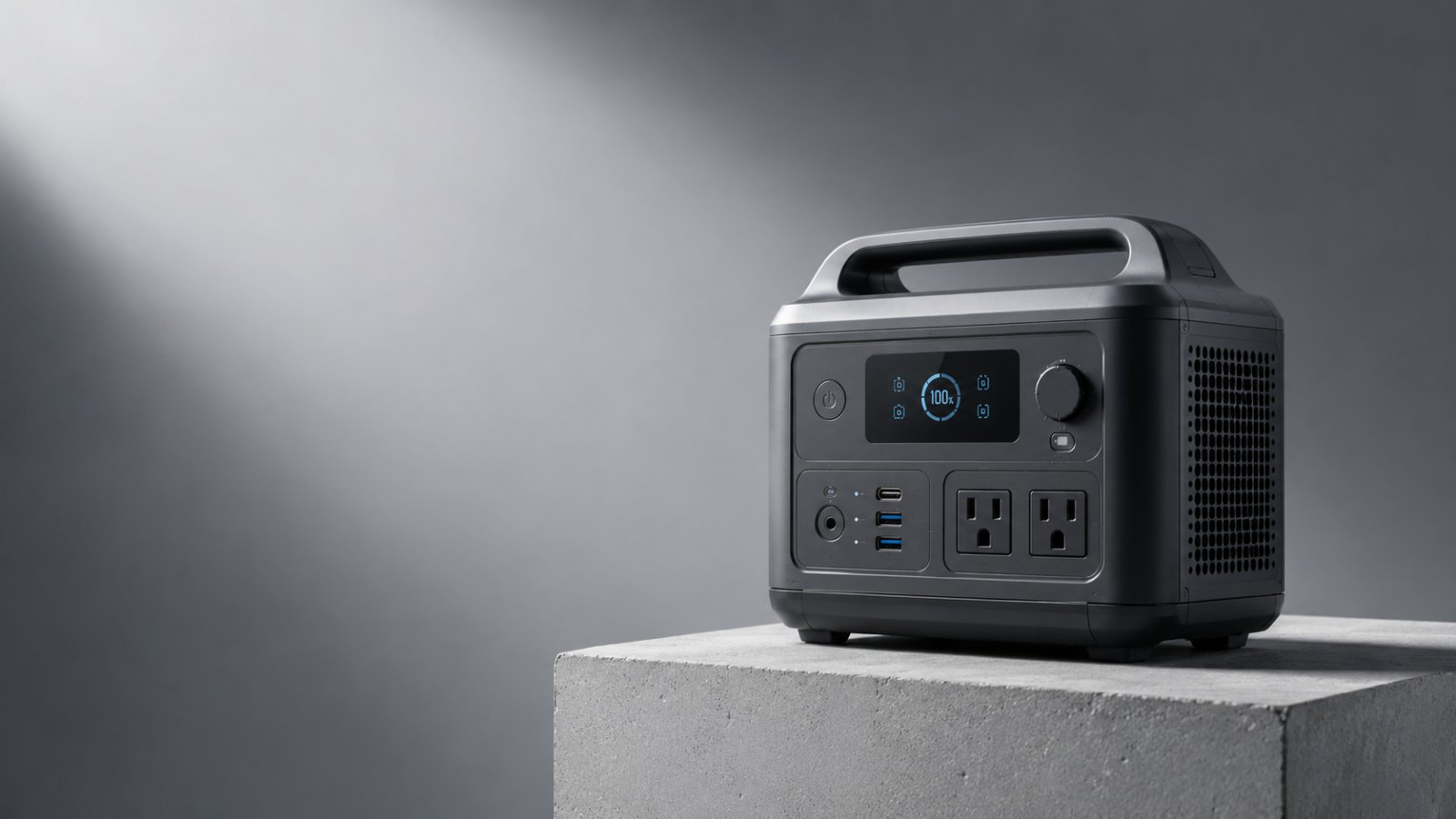
Pick it up and the appeal is immediate. At 24.4 pounds, the Explorer 1000 v2 is noticeably lighter than most 1 kWh competitors — the EcoFlow Delta 2, for comparison, is about 27 pounds, and it feels like more. The folding handle is comfortable, the footprint is compact enough to tuck behind a car seat, and the whole thing has that reassuring, well-finished Jackery feel.
The front panel is a model of clarity: a bright display shows input, output, remaining charge, and estimated time, and everything is labeled so plainly that a first-time user won’t need the manual. Three AC outlets, two USB-C, one USB-A, and a car port cover the essentials. If there’s a nitpick, it’s that some rivals cram in more outlets — but for most real-world use, this layout is plenty.
Real-world performance
The 1,500 W inverter is the number that defines this unit. It comfortably runs the things most people actually plug in: a mini-fridge, a CPAP, laptops, phones, a TV, lights, a fan, routers, and small kitchen gadgets like a blender or coffee maker. The 3,000 W surge headroom means motor-driven devices (that fridge compressor) start without drama.
Where you hit the ceiling is high-draw heating appliances. A 1,500 W space heater, a hair dryer on high, or a full-size microwave will meet or exceed the limit — this isn’t the unit for those. That’s the trade-off for its light weight, and it’s the right call for its target buyer.
On runtime, the math is friendly. With ~1,070 Wh and real-world losses, expect roughly:
Mini-fridge (~50 W average): most of a day, ~15–18 hours
CPAP (~30–40 W, no humidifier): two to three nights
Laptop (~60 W): ~13–15 recharges
Phone: 60+ full charges
Full-size fridge (~1–1.5 kWh/day): roughly 8–12 hours
Those are exactly the loads campers and outage-preppers care about, and the v2 handles them all quietly and coolly.
Charging: fast where it counts
This is where the v2 leaves the original in the dust. Wall charging hits full in about 1.5 hours using Jackery’s fast mode — quick enough that you can top off in the window between “storm warning” and “lights out.” It accepts up to 400 W of solar, so pairing it with Jackery’s SolarSaga panels makes it a capable off-grid unit; in good sun you can bank a meaningful chunk of a day’s use. There’s also a 12V car input for charging on the drive to the campsite.
App and features
The v2 works with the Jackery app over Bluetooth and Wi-Fi, letting you monitor charge, tweak settings, toggle a quieter charging mode, and check status from your phone. It’s not the most feature-dense app in the category — EcoFlow’s is deeper — but it’s stable and does what you need. Honestly, the physical controls are so clear that many owners rarely open the app at all.
A real-world weekend test
Numbers on a spec sheet are one thing; a campsite is another. Picture a typical weekend: start fully charged, run a 45 W car fridge around the clock, string up a couple of LED lights each evening, and top off two phones and a tablet nightly. That’s roughly 700–800 Wh a day, so the v2’s 1,070 Wh comfortably clears a full day and pushes into a second before you need the sun or a wall outlet. Add a 200 W solar panel catching a few good hours and the Explorer 1000 v2 becomes effectively self-sustaining for a fridge-and-devices camp — precisely the job Jackery designed it for.
Push it harder — a 700 W electric skillet for breakfast — and you’ll draw about 0.4 kWh over a 35-minute cook, still leaving most of the battery for the day. The only wall it hits is sustained high-wattage heat, so the space heater and hair dryer stay home.
Is the Explorer 1000 v2 worth the money over time?
At MSRP, the $799 sticker looks steep next to the heavily discounted EcoFlow Delta 2 — that’s the honest knock. But value isn’t just the day-one price. The v2’s LiFePO4 cells are rated for 4,000 cycles; charge and drain it fully once a week and you’re looking at well over a decade before it noticeably fades, all under a 5-year warranty. Spread across that lifespan, the cost-per-year is genuinely low. The move that turns a good buy into a great one is simple: wait for a sale. Jackery discounts this unit constantly, and anywhere near $469 it’s one of the best values in portable power.
Ports, accessories, and everyday use
On the connectivity front you get three AC outlets, two 100 W USB-C ports, a USB-A, and a 12V car socket — enough to run a small campsite or desk without a power strip. In the box, Jackery includes the unit, an AC charging cable, and a car-charging cable; solar panels are sold separately or bundled. Day to day it runs cool and near-silent at typical loads, the handle folds flat for packing, and the display’s time-to-empty estimate is genuinely useful for planning your evening. It’s the kind of unit that fades into the background and just works — which, for most people, is exactly the point.
Pros and cons
Pros
Lightest 1 kWh-class unit in its bracket at 24.4 lb
Long-life LiFePO4 battery (4,000 cycles) with a 5-year warranty
Fast ~1.5-hour wall charging
Genuinely beginner-friendly interface
Frequently discounted well below MSRP
Cons
1,500 W output ceiling limits heavy appliances
Fewer expansion options than EcoFlow/Bluetti platforms
App is functional but basic
MSRP is high (buy it on sale)
How it compares
Against the EcoFlow Delta 2, the Jackery is lighter and simpler, while the EcoFlow offers a higher 1,800 W output, faster expansion, and often an even lower sale price. Against the EcoFlow Delta 3, the Delta 3 wins on output and expandability, but the Jackery counters with lower weight and that plug-and-play simplicity. We put all three brands head-to-head in EcoFlow vs Jackery vs Bluetti if you’re cross-shopping.
The short version: choose the Explorer 1000 v2 when portability and simplicity top your list, and look at EcoFlow when you want maximum output and expandability.
Who should buy the Jackery Explorer 1000 v2?
Buy it if you’re a camper, tailgater, or first-time power-station owner who wants a light, friendly unit that covers essentials without a learning curve. It’s ideal for keeping a fridge, CPAP, and devices running on trips or during shorter outages. Skip it if you need to power space heaters, run a whole home, or want a big expandable backup system — those buyers should look at higher-output or 240V units.
Limitations and who this isn’t for
This is a research-based overview using manufacturer specifications, not our own measurements. The Explorer 1000 v2 is a smaller-capacity unit aimed at phones, laptops, lights and CPAP — not fridges for long or any 240V load. Runtime and recharge numbers are best-case ratings; verify the current price and warranty before buying.
How we source this guide: capacities, runtimes and prices are drawn from manufacturer documentation and reputable public sources and can change. Always confirm current specifications and pricing on the manufacturer’s website before buying.
Frequently asked questions
Is the Jackery Explorer 1000 v2 worth it? For its target use — camping, portability, and essentials backup — yes. The move to a 4,000-cycle LiFePO4 battery, the light 24.4-lb weight, and fast charging make it a strong value, especially on sale near $469. It’s only “not worth it” if you specifically need to run high-wattage heating appliances.
What can the Jackery Explorer 1000 v2 run? Fridges, CPAPs, laptops, phones, TVs, lights, fans, routers, and small kitchen appliances. Its 1,500 W limit rules out space heaters, hair dryers on high, and large microwaves.
How long does the Jackery 1000 v2 last on a full charge? It depends on the load: roughly 15–18 hours for a mini-fridge, two to three nights for a CPAP, or 60+ phone charges. A full-size fridge runs about 8–12 hours.
Does the Jackery Explorer 1000 v2 use LiFePO4? Yes. Unlike the original Explorer 1000, the v2 uses a LiFePO4 battery rated for 4,000 cycles and backed by a 5-year warranty.
How long does it take to charge? About 1.5 hours from a wall outlet in fast mode, or a full day of good sun with 400 W of solar panels.
Does the Jackery Explorer 1000 v2 have an app? Yes. It connects over Bluetooth and Wi-Fi to the Jackery app for monitoring charge, adjusting charging speed, and checking status remotely — though the clear onboard display means many owners rarely open it.
Can the Explorer 1000 v2 be charged by solar? Yes, it accepts up to 400 W of solar input. Paired with Jackery’s SolarSaga panels, it can recharge in a day of good sun, making it a capable off-grid companion.
Is the Jackery Explorer 1000 v2 good for a power outage? Yes, for essentials. Its 1,500 W output runs a fridge, lights, internet, and device charging, and its 1,070 Wh keeps them going for most of a day. For heavy appliances or whole-home backup, step up to a higher-output or 240V unit.
The bottom line
The Jackery Explorer 1000 v2 doesn’t try to be the most powerful unit on the shelf — it tries to be the easiest good one, and it succeeds. Light, durable, fast-charging, and refreshingly simple, it’s the power station we’d hand to a friend who’s never owned one. Just wait for one of Jackery’s frequent sales, grab it near $469, and you’re getting one of the best portable-power values of 2026.