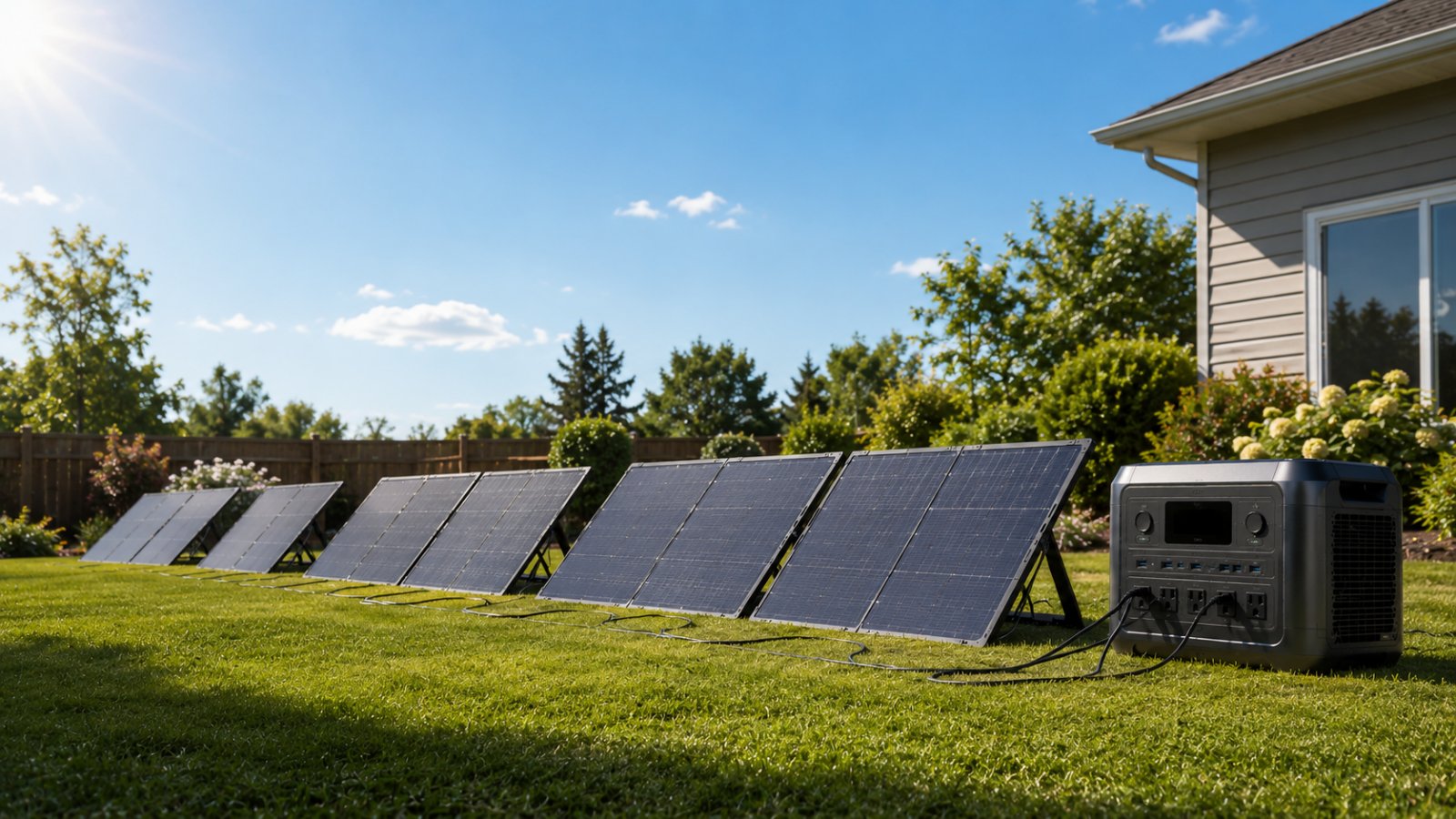
How Many Solar Panels to Charge a Solar Generator?
Quick answer: to recharge a solar generator in a single day of good sun, you generally want solar panel wattage roughly equal to 20–40% of the battery’s watt-hours. So a 1,000 Wh unit wants about 200–400 W of panels, a 2,000 Wh unit about 400–800 W, and a 3,800 Wh unit about 800–1,600 W. The exact number depends on your panels, your local sun hours, and the station’s maximum solar input.
That’s the shortcut. But understanding the simple math behind it lets you size your panels precisely — and avoid the classic mistake of buying a big battery and a tiny panel that takes three days to fill it.
The formula
Solar panels don’t deliver their rated wattage all day — they only produce meaningful power during peak sun hours (the hours when sunlight is strong enough to hit near-rated output, typically 4–6 hours a day in most of the U.S.), and even then at 80–92% of the rating due to heat and angle. Here’s the formula that accounts for all of it:
Panels needed (watts) = Battery capacity (Wh) ÷ (Peak sun hours × 0.75)
The 0.75 is a real-world efficiency factor (covering panel losses, heat, and charging inefficiency). Flip it around to find charge time:
Charge time (hours) = Battery capacity (Wh) ÷ (Panel wattage × 0.75) — then divide by usable sun hours per day.
Example: To recharge a 1,000 Wh station in one day with 5 peak sun hours: 1,000 ÷ (5 × 0.75) = 267 W of panels. So roughly 300 W (say, a 200 W plus a 100 W panel, or a single 300 W) refills it in a sunny day. A single 100 W panel, by contrast, would take two to three days — which is why undersizing is the most common error.
Panels needed by solar generator size
Assuming about 5 peak sun hours (a reasonable U.S. average) and a goal of a full recharge in one day:
| Battery capacity | Panels for 1-day recharge | Charge time with 200 W | Charge time with 400 W |
|---|---|---|---|
| 500 Wh | ~130–200 W | ~3–4 hrs | ~2 hrs |
| 1,000 Wh | ~270–400 W | ~7 hrs (≈1.5 days) | ~3.5 hrs |
| 2,000 Wh | ~530–800 W | ~13 hrs (≈2.5 days) | ~7 hrs |
| 3,800 Wh | ~1,000–1,500 W | not practical | ~13 hrs (≈2.5 days) |
“Charge time” assumes real-world output; spread across ~5 sun hours a day to estimate days.
The takeaway: bigger batteries need proportionally bigger panel arrays to recharge in a reasonable time. If you only have a small panel, you can still top up over multiple days — just don’t expect a same-day refill.
What are “peak sun hours”?
This is the concept that trips people up. Peak sun hours are not the hours of daylight — they’re the equivalent hours of full-strength (1,000 W/m²) sunlight your location gets per day. A place might have 12 hours of daylight but only 5 peak sun hours, because early morning, late afternoon, and cloudy periods produce far less. Sunny southwestern states might see 6+ peak sun hours; cloudy northern regions in winter might see 3 or fewer. Fewer sun hours means you need more panel wattage (or more patience) to recharge.
Don’t exceed the station’s maximum solar input
Here’s a critical limit: every power station has a maximum solar input (e.g., 400 W, 500 W, 1,200 W). You can’t feed it more than that — extra panel wattage beyond the max is simply wasted, and a panel with too high a voltage can shut charging off. So before you buy panels:
Check your station’s max solar input (in its specs).
Size your panels up to — but not beyond — that limit for the fastest possible recharge.
Check the voltage window if mixing brands, so the panel’s open-circuit voltage stays within the controller’s range.
If your battery is bigger than your station’s solar input allows you to recharge in a day, that’s fine for backup use — you’ll just recharge over multiple days, or supplement with wall/car charging.
Tips for faster solar charging
Angle the panels at the sun. A panel lying flat produces far less than one tilted toward the sun. Adjust it through the day if you can — even a few repositions make a real difference.
Chase the light and avoid shade. Even partial shade on one cell can tank a whole panel’s output. Keep panels in full, unobstructed sun.
Buy a bit more panel than the math suggests. Real-world conditions are rarely ideal, so a little extra wattage ensures you actually hit a full charge.
Keep panels cool and clean. Excess heat lowers output, and dust or pollen blocks light. A quick wipe and good airflow help.
For the panels themselves, see Best Portable Solar Panels for Power Stations, and to size the whole system (battery plus solar) for your home, see How to Size a Solar Generator for Your Home.
Limitations and who this isn’t for
Panel-count math is an estimate: real output depends on sun angle, season, shade, temperature and panel quality, and panels typically deliver well below their rated watts. There is also an input limit — every unit caps how many watts of solar it accepts. Plan for more panels than the ideal-case math suggests, and check your unit’s maximum solar input before buying.
How we source this guide: capacities, runtimes and prices are drawn from manufacturer documentation and reputable public sources and can change. Always confirm current specifications and pricing on the manufacturer’s website before buying.
Frequently asked questions
How many solar panels do I need to charge a 1000W solar generator? For a 1,000 Wh unit, about 200–400 W of panels recharges it in a sunny day (roughly two to four standard 100W panels, or a single 300–400W panel). A single 100W panel would take two to three days.
How long does it take to charge a solar generator with solar panels? It depends on panel wattage and sun. As a rule, a panel array sized to 20–40% of the battery’s watt-hours refills it in one sunny day. Smaller panels take multiple days; larger arrays (up to the station’s input limit) charge faster.
Can one solar panel charge a solar generator? Yes, but slowly for larger units. A single 100W panel can maintain or slowly charge a small station, but a 1,000 Wh or larger unit needs multiple panels (or one high-wattage panel) for a same-day recharge.
How much solar do I need for a 2000Wh solar generator? Roughly 400–800 W of panels to recharge in a day of good sun, provided it’s within the station’s maximum solar input. Check that limit before buying panels.
What are peak sun hours? The equivalent hours of full-strength sunlight your location receives per day — typically 4–6 in most of the U.S., fewer in cloudy or winter conditions. They determine how much energy your panels can actually produce.
The bottom line
To recharge a solar generator in a day, size your panels to about 20–40% of the battery’s watt-hours — 200–400 W for a 1,000 Wh unit, and up from there — while staying within the station’s maximum solar input. Account for peak sun hours (usually 4–6), buy a little more panel than the math suggests, angle it at the sun, and keep it out of shade. Do that, and your battery fills back up while you’re out enjoying the day.