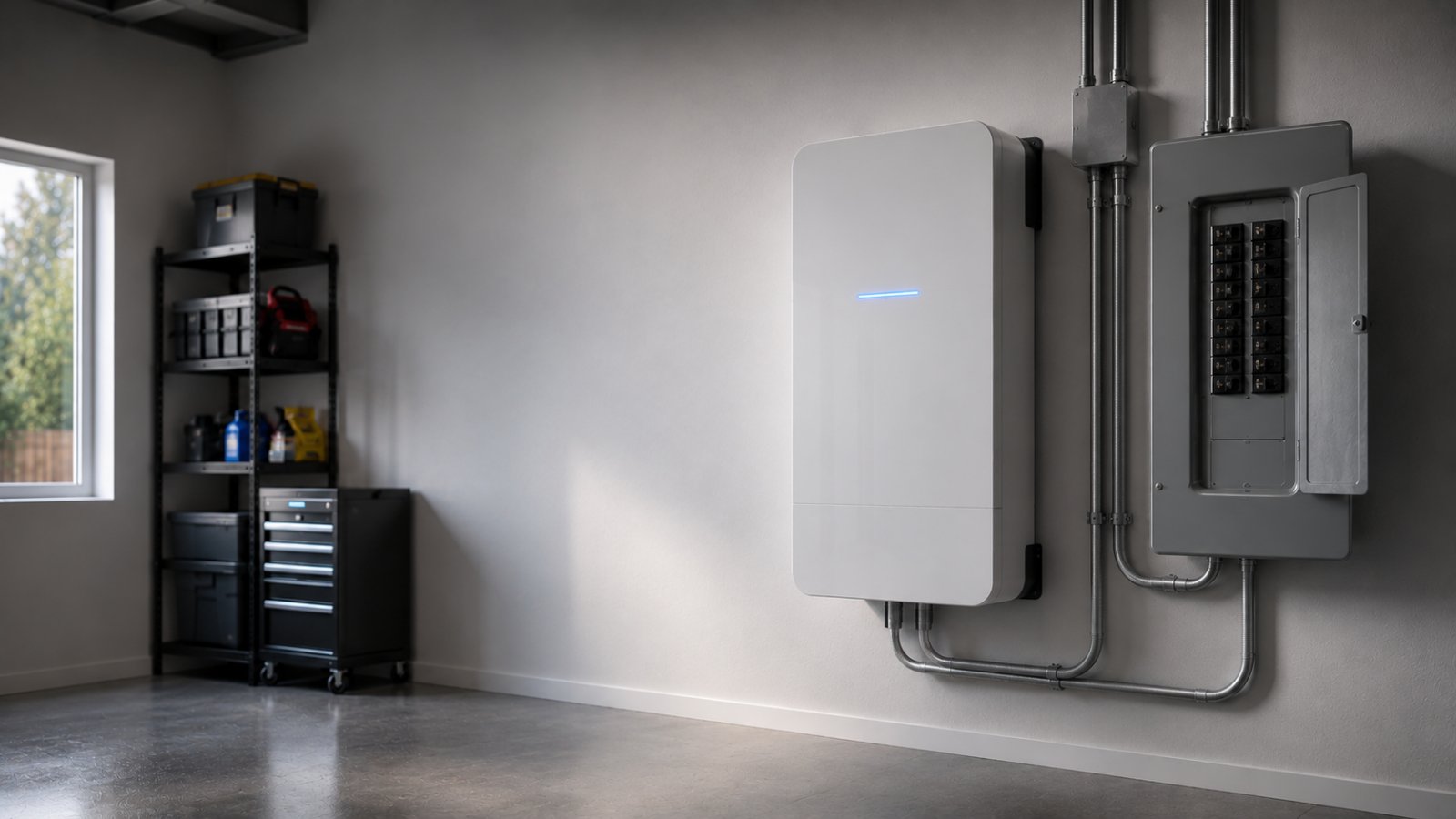
Whole-House Battery Backup Without Solar: Is It Possible?
Quick answer: yes, whole-house battery backup without solar is absolutely possible. A home battery charges directly from the grid, so it can back up your entire house during an outage and even lower your bills through time-of-use arbitrage — all without a single solar panel. Systems like the Tesla Powerwall 3, EcoFlow Delta Pro Ultra, and Anker SOLIX X1 all work perfectly on grid power alone.
There’s a common misconception that home batteries and solar panels are a package deal. They’re not. Here’s exactly how battery backup works without solar, what you need, and where the approach makes sense.
Note: This is general guidance, not financial advice. Whole-home 240V installations require a licensed electrician.
How battery backup works without solar
A home battery doesn’t care where its electricity comes from — solar panels or the grid, it stores energy the same way. Without solar, the flow is simple:
- The battery charges from the grid — ideally during cheap, off-peak hours.
- It sits fully charged, ready and waiting.
- When the grid goes down, the battery automatically takes over, powering your home.
- When the grid returns, it recharges itself for next time.
That’s genuine whole-house backup, no panels required. The battery is essentially a giant, silent, automatic UPS for your entire home.
What you need for whole-house backup without solar
Three things make it work:
Enough capacity (kWh). To back up a whole house, you need enough stored energy for your usage. A typical home uses around 30 kWh a day, but during an outage you’ll run essentials, which is far less — often 10–20 kWh a day. Size the battery (or batteries) to cover the outage length you’re planning for. Our guide How Many Batteries to Power a House During an Outage? has the math.
A 240V split-phase system. To power your whole panel — including hard-wired 240V appliances like a well pump, central AC, or electric range — you need a system with true 240V split-phase output. Most whole-home batteries have this.
Proper connection. A licensed electrician wires the battery to your panel through a backup gateway or transfer switch, which isolates your home from the grid during an outage (protecting utility workers) and manages the automatic switchover.
The two big benefits of a grid-charged battery
1. Reliable outage backup. This is the main event. Your house keeps running — fridge, lights, internet, heating/cooling, medical devices — silently and automatically when the grid fails. No fuel, no noise, no fumes.
2. Bill savings through time-of-use arbitrage. In areas with time-of-use (TOU) electricity rates, you charge the battery when power is cheap (overnight, off-peak) and use that stored energy when power is expensive (late afternoon/evening peak). Instead of buying pricey peak power, you use your own cheap stored power. Over time, that rate spread can offset part of the battery’s cost — no solar needed.
The one real limitation to understand
Here’s the honest caveat: without solar, your battery’s outage runtime is limited to whatever you stored before the outage. In a multi-day blackout with no grid to recharge from, the battery will eventually run down — you can’t refill it from the sun.
In practice, this matters less than it sounds. Most outages last hours, not days, and a properly sized battery easily covers them. For longer outages, you can extend runtime by conserving (running only essentials), by stacking more battery capacity, or by keeping a small generator as a backstop to recharge the battery. But if your primary concern is surviving long, multi-day outages off-grid, that’s exactly where adding solar (or a generator) earns its place. For typical outages, grid-charged battery backup is more than enough.
Best whole-house batteries that work without solar
Any of these back up a whole home on grid power alone:
Tesla Powerwall 3 — 13.5 kWh, 11.5 kW, seamless whole-home backup, grid-charges and does TOU arbitrage beautifully. Premium installed system.
EcoFlow Delta Pro Ultra — scales to 90 kWh with 240V output, charges fast from the grid, far lower cost per kWh, minimal permanent install. Best value.
Anker SOLIX X1 — modular to 180 kWh, 240V, grid-chargeable, clean install. Best scalability.
EcoFlow Delta Pro 3 / Anker SOLIX F3800 — plug-in units with 240V output that back up key circuits or whole-home essentials through a transfer switch, no solar and no major install. Best value plug-in.
See Best Battery Backup for a Home Without Solar Panels for the full rundown of picks.
Should you add solar later?
You can, and most systems are solar-ready — so starting battery-only doesn’t close the door. Add solar later if you want to recharge during long outages, cut your bills further, or move toward energy independence. But for pure backup and TOU savings, a grid-charged battery delivers on day one, at a lower upfront cost than a full solar-plus-storage project.
Limitations and who this isn’t for
A grid-charged battery backs up your home only until the stored energy runs out. In a multi-day outage without solar or a generator, you will lose power once it’s depleted. Sizing for true whole-home backup (AC, electric heat, well pump) gets expensive fast, so this suits short, frequent outages or essential-loads backup better than long-haul resilience.
How we source this guide: capacities, runtimes and prices are drawn from manufacturer documentation and reputable public sources and can change. Always confirm current specifications and pricing on the manufacturer’s website before buying.
Frequently asked questions
Can you have whole-house battery backup without solar? Yes. Batteries charge from the grid and back up your entire home during outages, with no solar panels required. Systems like the Tesla Powerwall 3, EcoFlow Delta Pro Ultra, and Anker SOLIX X1 all work on grid power alone.
How does a battery charge without solar? It charges directly from the grid — ideally during cheap off-peak hours — then discharges during outages or expensive peak-rate periods. It recharges from the grid again once power returns.
What’s the downside of battery backup without solar? The main limitation is that during a multi-day outage with no grid, the battery can’t recharge itself (no solar to refill it), so runtime is limited to stored energy. For typical outages of hours, this isn’t an issue; for long off-grid events, adding solar or a generator helps.
Does a battery without solar save money? It can, through time-of-use arbitrage: charge when grid power is cheap, use it when power is expensive. Savings depend on your utility’s rate spread. Its primary value, though, is reliable outage backup.
Do I need an electrician for whole-house battery backup? Yes, for a permanent 240V whole-home installation — a licensed electrician wires it to your panel through a backup gateway or transfer switch. Plug-in units backing up individual circuits need less or no installation.
The bottom line
Whole-house battery backup without solar is not only possible — it’s a practical, popular choice in 2026. A grid-charged battery keeps your entire home running through outages and can trim your bills through time-of-use arbitrage, all without the cost and complexity of a rooftop array. The only real limit is multi-day, no-grid runtime, which matters mainly for long off-grid events. For the outages most people actually face, a grid-charged whole-home battery — from a Tesla Powerwall 3 to a value EcoFlow or Anker system — is silent, automatic, and ready the moment you need it. Panels optional.