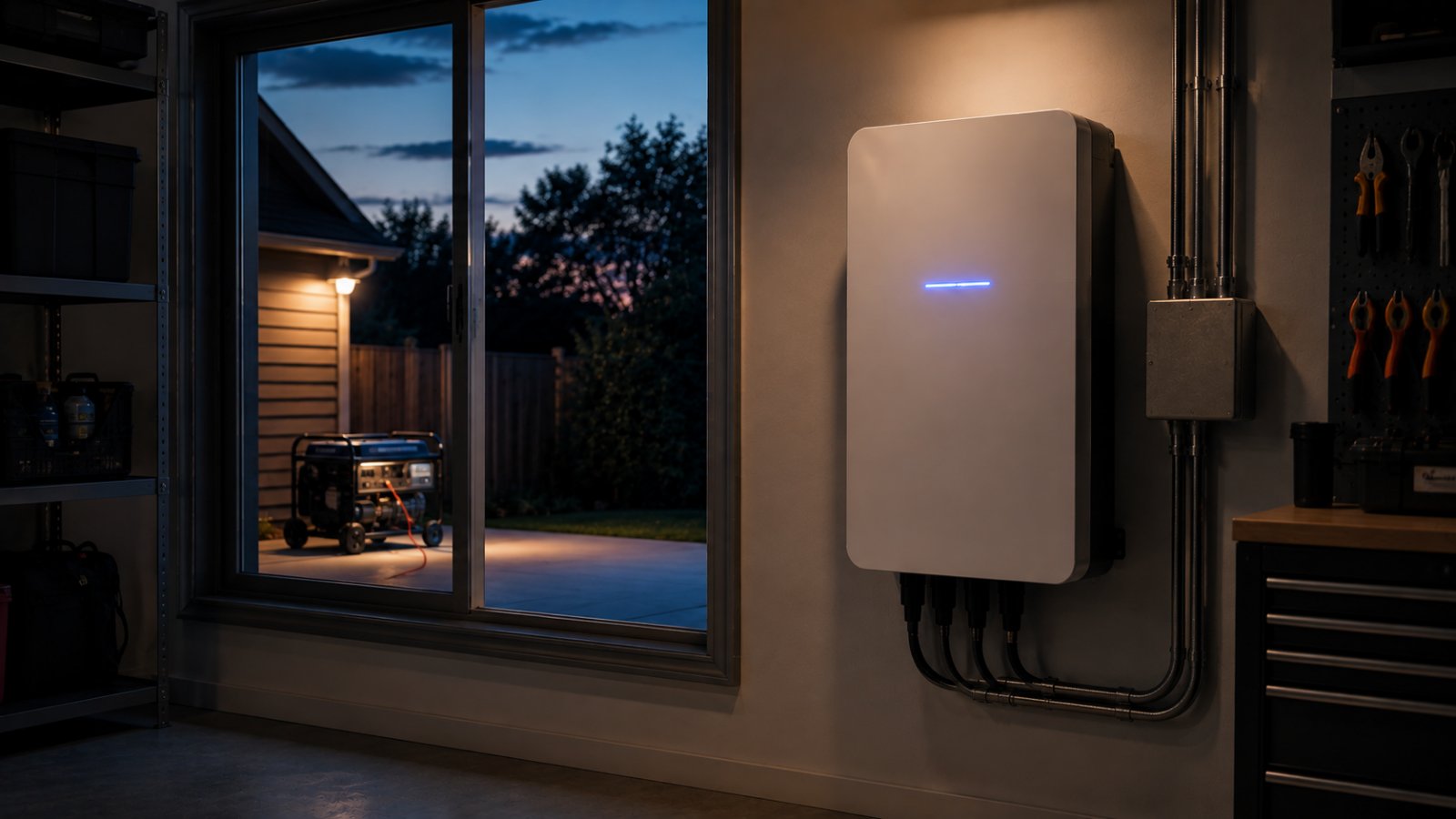
Home Battery Backup vs Generator: Cost and Pros/Cons
When you decide it’s time to stop losing power every storm, you face a fork in the road: a home battery backup system or a backup generator. Both keep your lights on, but they do it in completely different ways, with very different costs, trade-offs, and day-to-day realities. Picking the right one saves you thousands and a lot of frustration.
Here’s the honest, head-to-head comparison of home battery backup vs generator for 2026 — cost, pros, cons, and who each one is really for.
Note: Cost figures are general information, not financial advice. Prices vary by home and region; get quotes for your situation.
The quick verdict
- Home battery backup wins for silent, clean, automatic power, bill savings, and short-to-medium outages — especially paired with solar. No fuel, no fumes, no maintenance.
- A generator wins for long, multi-day outages and unlimited runtime as long as you have fuel, often at a lower upfront cost for high output.
- The best-protected homes often use both: a battery for silent, instant, everyday backup, and a generator as a fuel-fed backstop for rare, extended outages.
Side-by-side comparison
|
Factor |
Home Battery Backup |
Backup Generator |
|---|---|---|
|
Noise |
Silent |
Loud (except pricey inverter models) |
|
Emissions |
None |
Exhaust + carbon monoxide |
|
Safe indoors |
Yes |
No (outdoors only) |
|
Fuel |
None (grid/solar) |
Gas, propane, or natural gas |
|
Runtime |
Limited by capacity |
Unlimited with fuel |
|
Startup |
Instant, automatic |
Automatic (standby) or manual (portable) |
|
Maintenance |
Almost none |
Regular (oil, filters, fuel) |
|
Bill savings |
Yes (time-of-use, solar) |
No |
|
Lifespan |
~10–15 years |
~10–20 years (with upkeep) |
|
Upfront cost (whole-home) |
~$10,000–$20,000+ installed |
~$5,000–$15,000 installed (standby) |
Cost comparison
Home battery backup. A professionally installed whole-home system typically runs $10,000–$20,000+ (a single Tesla Powerwall 3 is about $13,000–$16,500 installed). Plug-in battery units that back up essentials cost far less — $1,000–$5,000. Note that the 30% federal tax credit ended after 2025, so 2026 battery costs are higher in real terms. See our full breakdown in How Much Does a Home Battery Backup System Cost in 2026?.
Generators. A permanently installed whole-home standby generator (like a Generac) typically costs $5,000–$15,000 installed, including the automatic transfer switch and often a natural-gas or propane hookup. A portable gas generator is far cheaper — $500–$2,000 — but requires manual setup, outdoor operation, and refueling.
The ongoing costs flip the picture. A generator costs money every time it runs (fuel) plus regular maintenance (oil changes, filters, servicing). A battery runs on cheap grid power or free solar and needs virtually no maintenance — and can even save money through time-of-use arbitrage. So a generator is often cheaper to buy but more expensive to own; a battery is the reverse.
Home battery backup: pros and cons
Pros
- Completely silent
- Zero emissions — safe to run indoors and anywhere
- Instant, automatic switchover (no startup delay)
- No fuel to buy, store, or run out of
- Almost no maintenance
- Can lower your electricity bill (time-of-use, solar)
- Pairs with solar for renewable, rechargeable power
Cons
- Higher upfront cost, especially without the tax credit
- Limited runtime — can’t refill without grid or solar
- Multi-day outages require large capacity or solar
- Whole-home systems need professional installation
Generators: pros and cons
Pros
- Unlimited runtime as long as you have fuel
- Lower upfront cost for high output
- Excellent for long, multi-day outages
- Natural-gas models never need refueling (piped-in fuel)
- Handles the heaviest whole-home loads
Cons
- Loud (most models)
- Produces exhaust and carbon monoxide — outdoors only
- Requires fuel (storage, cost, or a gas line)
- Regular maintenance (oil, filters, servicing)
- No bill savings — only runs during outages
- Startup delay on portable models (manual)
Which is right for you?
Choose a home battery if: you want silent, clean, instant, automatic backup; your outages are typically hours to a day or two; you have or plan to add solar; you want to save on your electricity bill; or you simply don’t want to deal with fuel and maintenance. This fits the majority of homeowners.
Choose a generator if: you face frequent multi-day outages; you need to run heavy whole-home loads continuously for days; you want the lowest upfront cost for high output; or you have a natural-gas line for unlimited runtime. It’s the workhorse for long, severe outages.
Choose both if: you want maximum resilience. Many well-prepared homes use a battery for silent, instant, everyday backup — covering the vast majority of outages seamlessly — and keep a generator (ideally natural gas or propane) as a backstop for the rare multi-day event. The battery handles daily life and short outages elegantly; the generator guarantees you never run out during a marathon blackout. It’s the belt-and-suspenders approach.
The 5-year cost scenario
Numbers make the trade-off concrete. Imagine two homeowners preparing for outages. The first installs a standby generator for around $9,000; over five years they spend on fuel during outages, plus annual servicing and oil changes — call it several hundred dollars a year — so their five-year total climbs well beyond the sticker price. The second installs a home battery for around $13,000; it runs on cheap grid power or free solar, needs no maintenance, and in a time-of-use area actually trims their electric bill each month, chipping away at the upfront cost.
Five years in, the generator owner has paid more than the sticker in fuel and upkeep (and listened to a lot of engine noise), while the battery owner has spent almost nothing extra, enjoyed silent automatic backup, and clawed back some cost through bill savings. The generator still wins on one thing the battery can’t match — unlimited runtime in a week-long outage — but on total cost and daily experience, the battery closes the gap fast. Your local fuel prices, electricity rates, and outage patterns decide exactly where the lines cross.
What about a battery plus solar vs a generator?
This is increasingly the real comparison. A battery paired with solar can recharge itself every sunny day, dramatically extending runtime — closing much of the gap with a generator’s unlimited fuel-fed operation, while staying silent, clean, and maintenance-free. For homeowners weighing long-outage resilience, solar-plus-battery is the modern answer that competes directly with a generator, minus the fuel and noise. For pure ROI without incentives, though, weigh it carefully — see Is a Home Battery Worth It Without the Tax Credit in 2026?.
Limitations and who this isn’t for
Neither option wins outright. Batteries are quiet, instant and maintenance-free but limited by their stored capacity and expensive up front. Generators run as long as you have fuel but are noisy, need fuel and maintenance, and emit exhaust that is dangerous indoors. The right choice depends entirely on your typical outage length, budget and tolerance for noise and fuel.
How we source this guide: capacities, runtimes and prices are drawn from manufacturer documentation and reputable public sources and can change. Always confirm current specifications and pricing on the manufacturer’s website before buying.
Frequently asked questions
Is a home battery or a generator better? It depends on your needs. A home battery is better for silent, clean, automatic backup, bill savings, and short-to-medium outages, especially with solar. A generator is better for long, multi-day outages and unlimited runtime with fuel. Many homes use both.
Is a home battery cheaper than a generator? Usually higher upfront — a whole-home battery runs $10,000–$20,000+ installed vs $5,000–$15,000 for a standby generator. But a battery is cheaper to own (no fuel or maintenance) and can save on bills, while a generator has ongoing fuel and upkeep costs.
Can a home battery replace a generator? For most outages (hours to a day or two), yes — a battery does it silently, cleanly, and automatically. For long, multi-day outages with heavy continuous loads, a battery needs large capacity or solar to compete with a generator’s unlimited runtime.
Which is safer, a battery or a generator? A home battery is safer for indoor and enclosed use, since it produces no exhaust or carbon monoxide. Generators must always run outdoors, well away from windows, because of deadly carbon monoxide risk.
Do home batteries work during a power outage automatically? Yes. A home battery switches on instantly and automatically when the grid fails — often so fast that lights don’t flicker. Standby generators also start automatically but with a brief delay; portable generators must be started manually.
Which is cheaper over time, a battery or a generator? A generator is usually cheaper to buy but costs more to own (fuel plus maintenance every year). A battery costs more upfront but runs on cheap grid power or free solar with almost no upkeep, and can save on bills — so over many years the total costs often converge or favor the battery.
Can a battery and generator work together? Yes, and it’s the most resilient setup. The battery provides silent, instant, automatic backup for the vast majority of outages, while a generator (ideally natural gas or propane) serves as a fuel-fed backstop for rare multi-day events, and can even recharge the battery.
Is a whole-home battery loud like a generator? No. Home batteries are completely silent in operation — no engine, no exhaust. This is one of their biggest advantages over generators, which range from loud to very loud (only premium inverter models are quiet).
The bottom line
Home battery backup vs generator comes down to how you experience outages and what you value. A home battery is silent, clean, instant, maintenance-free, and can even lower your bills — ideal for the outages most people actually face, and better still with solar. A generator is the champion of long, multi-day outages and unlimited fuel-fed runtime, usually at a lower upfront cost. For most homeowners in 2026, a battery is the more elegant everyday solution; for severe-outage country, a generator (or both) earns its keep. Decide how long you need to last and how much silence and simplicity are worth to you, and the right choice becomes clear.